
Discriminant & Nature of Roots (Sign Diagram)
Loading the math board and drawing, please wait…
In collections
Discriminant & Nature of Roots
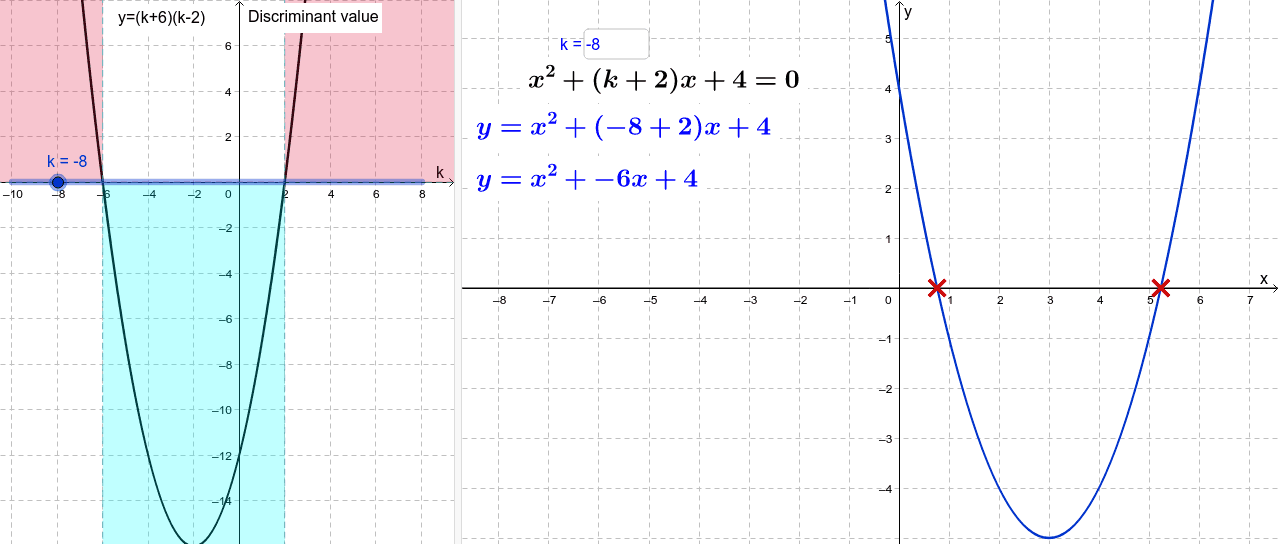
This example demonstrates the relationship between the discriminant and the nature of roots of a quadratic function through an intuitive sign diagram. Key math concepts include discriminant, root nature (real, complex, repeated roots), and quadratic function graphs. It is constructed using GeoGebra commands like Textfield, Intersect, and objects such as text1_2, text1, d, k, c, etc., making it suitable for high school mathematics education to understand the distribution of roots in quadratic equations.
GeoGebra Commands & Parameters
Textfield(k) → inputBox1Intersect(f, xAxis) → AIntersect(f, xAxis) → BIntersect(c, f, 2) → CIntersect(c, f, 1) → D
AI Drawing Prompt Reference
Draw a graph of a quadratic function and show the relationship between its discriminant and the nature of its roots. First, plot the intersection points between the function and the x-axis. Then, plot another intersection point between the function and a helper line. Next, find the intersection point of the two helper lines. Finally, plot the intersection points of these helper lines with the function. Use these points to illustrate whether the roots are real, complex, or repeated, and label the discriminant value and root nature with text.
The prompt above was compiled from the original drawing commands and is for reference only.