
Discriminant & Nature of Roots by shanlee
Loading the math board and drawing, please wait…
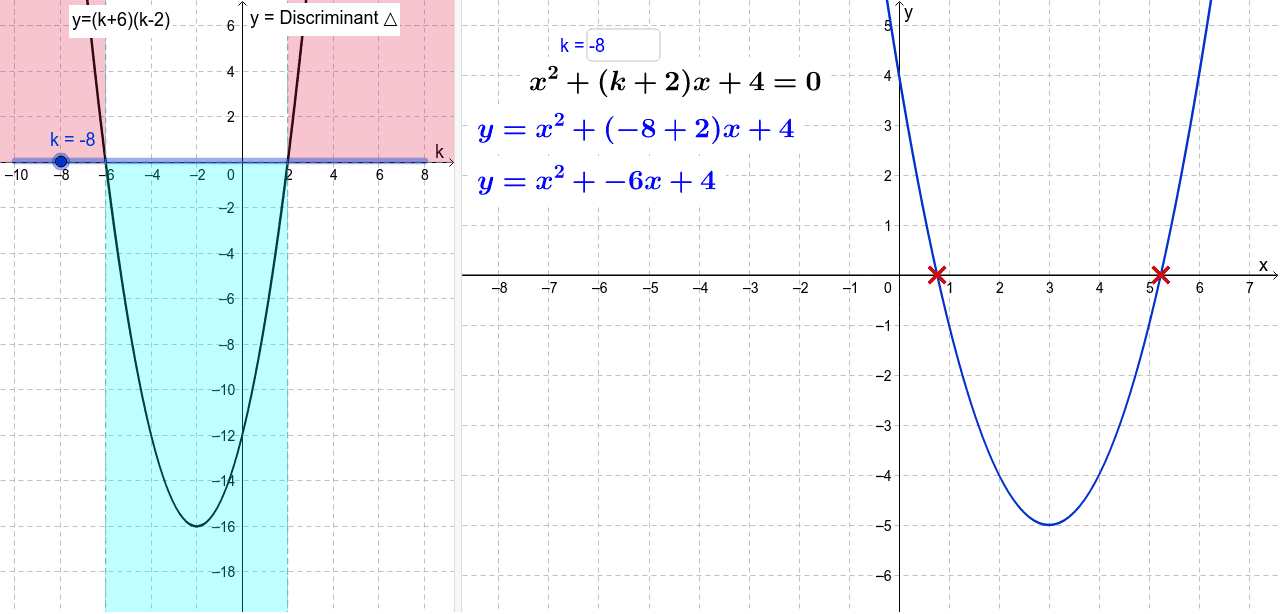
This GeoGebra example interactively demonstrates how the discriminant Δ=b²-4ac of a quadratic equation determines the nature of its roots: two distinct real roots, one repeated real root, or no real roots (complex roots). The core mathematical concepts include quadratic functions, the discriminant, and classification of real versus complex solutions. Construction highlights: the Textfield command creates input boxes for coefficients a, b, and c; the Intersect command finds the intersection points of the parabola with the x-axis, dynamically updating the discriminant value and root type; objects include text labels (text1, text2), an input box (inputBox1), and points A, B, C, D on the graph. This resource is ideal for middle school or high school algebra classes, enabling students to explore how changing coefficients affects the roots and to verify the discriminant theorem through hands-on experimentation.
GeoGebra Commands & Parameters
Textfield(k) → inputBox1Intersect(f, xAxis) → AIntersect(f, xAxis) → BIntersect(c, f, 2) → CIntersect(c, f, 1) → D
AI Drawing Prompt Reference
Draw a quadratic function graph and show its intersection points with the x-axis. Allow users to dynamically adjust coefficients a, b, c to demonstrate how the discriminant Δ=b²-4ac determines the nature of roots: two distinct real roots, one repeated real root, or no real roots (complex roots). Use input boxes for coefficient entry, calculate the discriminant value, and display different text labels based on root properties, while using sliders to dynamically show the relationship between inequalities and root changes.
The prompt above was compiled from the original drawing commands and is for reference only.