
Discrete Uniform Distribution U(N) with PDF and CDF
Loading the math board and drawing, please wait…
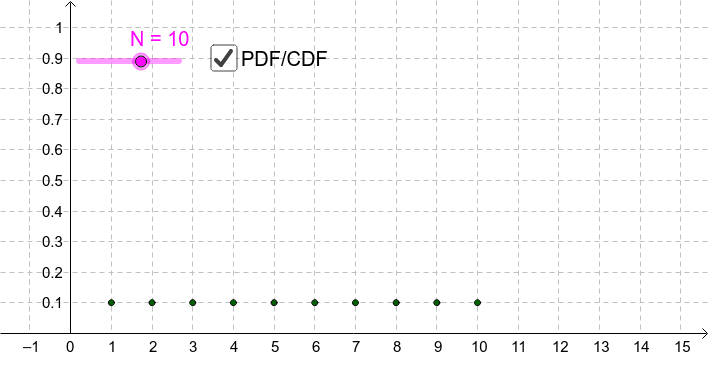
This example demonstrates the probability mass function (PDF) and cumulative distribution function (CDF) of the discrete uniform distribution U(N). By adjusting parameter N, users can observe the distribution changes. Key mathematical concepts include probability distribution functions and cumulative distribution functions. GeoGebra commands used include Sequence and Segment. Suitable for high school and above students learning probability and statistics.
GeoGebra Commands & Parameters
Sequence(k, k, 1, N) → list1Sequence(1 / N, k, 1, N) → list2Sequence((Element[list1, k], Element[list2, k]), k, 1, N) → list3Sequence(Sum[Take[list2, 1, k]], k, 1, N) → list4Sequence((Element[list1, k], Element[list4, k]), k, 1, N) → list5Sequence((Element[list1, k + 1], Element[list4, k]), k, 1, N - 1) → list6Sequence(Segment[Element[list5, k], Element[list6, k]], k, 1, N - 1) → list7Segment((Element[list1, 1] - 10, 0), (Element[list1, 1], 0)) → aSegment((Element[list1, Length[list1]], 1), (Element[list1, Length[list1]] + 10, 1)) → b
AI Drawing Prompt Reference
Draw the probability mass function (PDF) and cumulative distribution function (CDF) of the discrete uniform distribution U(N). First, create a sequence of integers from 1 to N, then plot the probability 1/N for each integer, next draw the PDF graph, then the CDF graph, and finally connect corresponding points on the PDF and CDF graphs with line segments.
The prompt above was compiled from the original drawing commands and is for reference only.