
Discrete to Continuous Ellipse Transformation
Loading the math board and drawing, please wait…
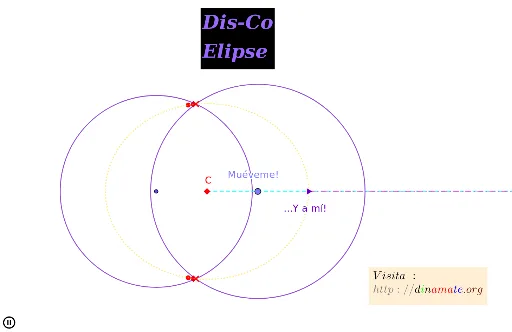
This GeoGebra example visualizes the transition from discrete points and segments to a continuous elliptical curve, illustrating how parametric construction can represent conic sections. Core mathematical concepts include the analytic geometry of ellipses, parametric equations, coordinate geometry, and three-dimensional vector representations of planar curves. Construction highlights involve the GeoGebra commands Segment, Point, Midpoint, Ellipse, Circle, and Intersect, applied to defined points and objects to build the elliptical path through sequential intersections and geometric constraints. The model is suitable for high school advanced geometry, analytic geometry courses, and early university multivariable calculus or mathematical modeling, offering an interactive way to explore the relationship between discrete construction and continuous parametric form of an ellipse.
GeoGebra Commands & Parameters
Segment((1, 0), (7, 0)) → fPoint(f) → ASegment((x(A) + 1, 0), (x(A) + 7, 0)) → gPoint(g) → BMidpoint(O, A) → CEllipse(O, A, D) → cCircle(O, p) → dCircle(A, x(B) - x(C) + x(B) - x(C) - p) → eIntersect(e, d) → E, F, ,
AI Drawing Prompt Reference
Visualize the transition from discrete points and segments to a continuous elliptical curve, showing how parametric construction represents conic sections. Start by drawing a horizontal line segment, extend two parallel line segments from its endpoints, find the midpoint, draw an ellipse centered at the origin with the midpoint as the radius, then draw a circle centered at the origin, and finally find the intersection points of the circle with another circle to form the elliptical path.
The prompt above was compiled from the original drawing commands and is for reference only.