
Dilations Project
Loading the math board and drawing, please wait…
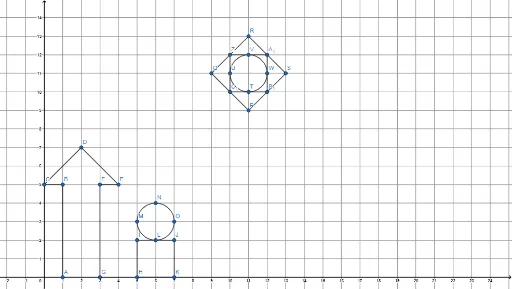
This example demonstrates the concept of dilations. It involves coordinate transformations and the properties of similar figures. Users can intuitively understand the principles of dilations through the use of points, line segments, circles, and other objects. The example is constructed using commands such as Point, Segment, and Circle in GeoGebra. Suitable for middle school and above students to learn geometric transformations.
GeoGebra Commands & Parameters
Point(yAxis) → CSegment(C, D) → gPoint(xAxis) → GSegment(F, G) → jSegment(B, C) → kPoint(xAxis) → HSegment(H, I) → lSegment(I, J) → mPoint(xAxis) → KSegment(J, K) → nSegment(K, H) → pCircle(M, N, O) → cSegment(P, Q) → qSegment(Q, R) → rSegment(R, S) → sSegment(S, P) → tCircle(U, V, W) → dPoint(r) → ZPoint(s) → A_1Segment(Z, A_1) → aPoint(t) → B_1Segment(A_1, B_1) → bPoint(q) → C_1Segment(B_1, C_1) → eSegment(C_1, Z) → f_1Segment(D, E) → fSegment(E, F) → hSegment(A, B) → i
AI Drawing Prompt Reference
Draw a figure with multiple points and segments. Start by taking a point C on the y-axis and connecting it to D. Then, take a point G on the x-axis and connect F to G. Next, connect B to C, and take a point H on the x-axis, connecting H to I, then I to J, and J to K, and K to H. Draw a circle with center M, N, O and connect P to Q, then Q to R, R to S, and S to P. Draw another circle with center U, V, W and take points Z and A_1 on it, connecting Z to A_1, then A_1 to B_1, take point C_1 on it, connecting B_1 to C_1, then C_1 to Z, and finally connecting D to E, E to F, and A to B.
The prompt above was compiled from the original drawing commands and is for reference only.