
Dilation & Rotation Demonstration
Loading the math board and drawing, please wait…
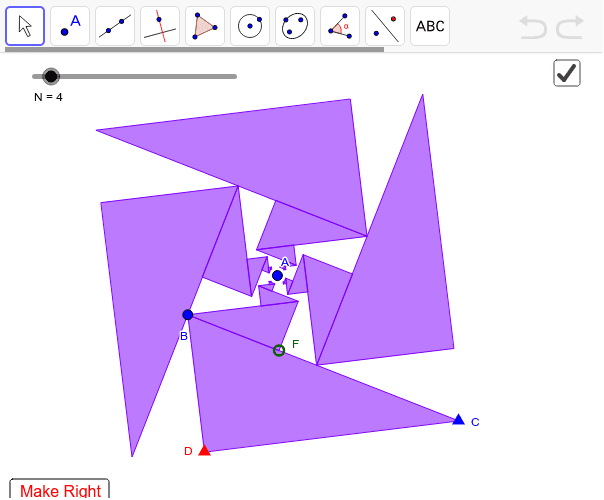
This example dynamically demonstrates the effects of geometric transformations like dilation and rotation on shapes using GeoGebra. It covers core math concepts including transformations, integers, quadratic functions, congruence, inequalities, and solid geometry. The construction utilizes commands and objects such as Rotate, Ray, Point, Semicircle, Polygon, Intersect, Dilate, and Sequence. Suitable for high school students studying geometric transformations, function graphs, and spatial geometry for classroom or self-exploration.
GeoGebra Commands & Parameters
Rotate(A, (((-(N - 2)) * 90) * ° / N), B) → A'Rotate(B, (((N - 2) * 90) * ° / N), B) → B'Ray(B', A') → aPoint(a) → CSemicircle(C, B) → cPolygon(C, B, D) → poly1, d, c_1, bPoint(d) → FIntersect(Line[F, b], c_1) → GDilate(Mirror[Rotate[Polygon[Translate[C, Vector[D, F]], Translate[B, Vector[D, F]], Translate[D, Vector[D, F]]], Angle[D, C, B], F], OrthogonalLine[F, d]], r, F) → poly3Dilate(Mirror[Rotate[Translate[B, Vector[D, F]], Angle[D, C, B], F], OrthogonalLine[F, d]], r, F) → EDilate(Polygon[Translate[C, Vector[C, E]], Translate[B, Vector[C, E]], Translate[D, Vector[C, E]]], r^(2), E) → poly2Dilate(Translate[B, Vector[C, E]], r^(2), E) → HDilate(Translate[poly3, Vector[B, H]], r^(2), H) → poly4Dilate(Translate[E, Vector[B, H]], r^(2), H) → IDilate(Translate[poly2, Vector[E, I]], r^(2), I) → poly5Dilate(Translate[H, Vector[E, I]], r^(2), I) → JDilate(Translate[poly4, Vector[H, J]], r^(2), J) → poly6Dilate(Translate[I, Vector[H, J]], r^(2), J) → KSequence(Rotate[{poly1, poly2, poly3, poly4, poly5, poly6}, ((i * 360) * ° / N), A], i, 1, N) → list1
AI Drawing Prompt Reference
Demonstrate geometric transformations like dilation and rotation. Start by drawing a polygon, then rotate it around a point. Connect the rotated vertices to the intersection points of a semicircle centered at the original point and a vertex. Perform dilation on multiple new polygons, and rotate them around the initial point in groups to create a dynamic sequence of transformed shapes, showing the relationship between geometric transformations, function graphs, and inequalities.
The prompt above was compiled from the original drawing commands and is for reference only.