
Dilation of the Triangle
Loading the math board and drawing, please wait…
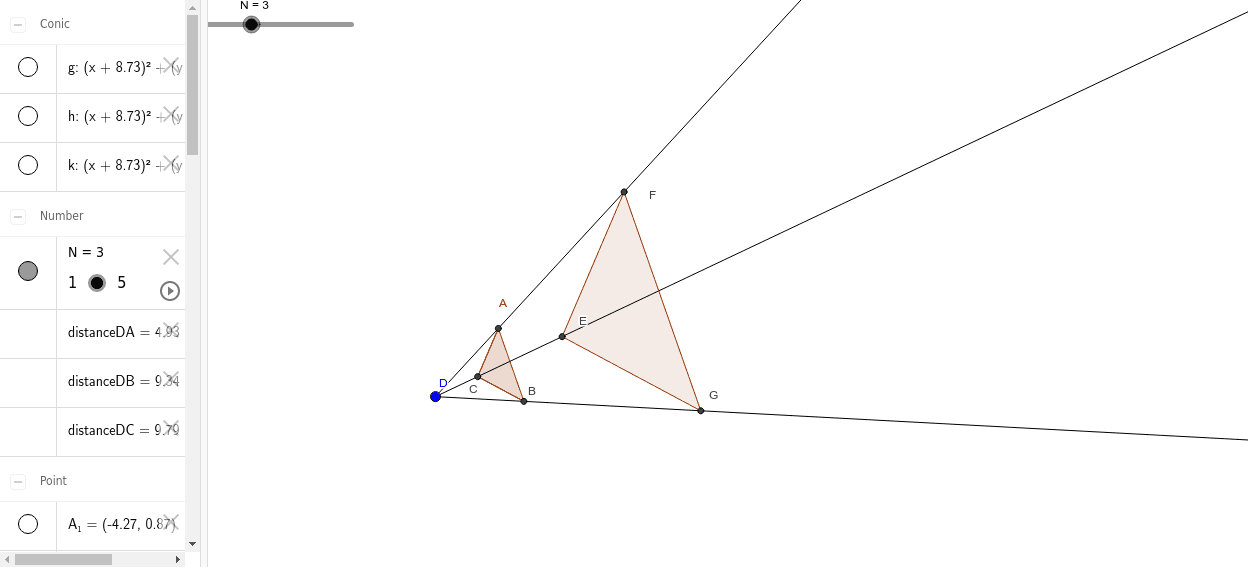
This example demonstrates the dilation transformation of a triangle. The core mathematical concepts involved include dilation, equilateral triangles, probability, piecewise functions, and limits. The construction utilizes GeoGebra commands such as Polygon, Ray, Distance, Circle, Intersect; objects include N, A_1, B_1, C_1, poly1, c_1, a_1, b_1, D, e, d, f, distanceDA, a, distanceDC, distanceDB, b, g, E, h, F, k, G, poly2, f_1, e_1, g_1, H, B, C, poly3, j, h_1, A. It is suitable for high school students learning geometric transformations and probability & statistics.
GeoGebra Commands & Parameters
Polygon(A_1, B_1, C_1) → poly1, c_1, a_1, b_1Ray(D, B_1) → eRay(D, A_1) → dRay(D, C_1) → fDistance(D, A_1) → distanceDADistance(D, C_1) → distanceDCDistance(D, B_1) → distanceDBCircle(D, (N * Distance[D, A_1])) → gIntersect(g, d, 1) → ECircle(D, (N * Distance[D, C_1])) → hIntersect(h, f, 1) → FCircle(D, (N * Distance[D, B_1])) → kIntersect(k, e, 1) → GPolygon(E, G, F) → poly2, f_1, e_1, g_1Intersect(b_1, f) → HIntersect(c_1, e) → BIntersect(c_1, b_1) → CPolygon(H, B, C) → poly3, j, h_1, A