
Dilation Exploration by rhoerner12
Loading the math board and drawing, please wait…
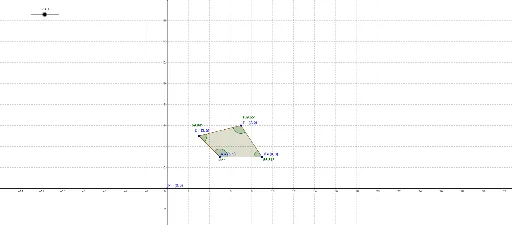
This example demonstrates the transformation of polygons under similarity (dilation), focusing on scale factors, angles, and geometric properties. It involves core concepts like dilation, similarity ratios, and coordinate geometry. Constructed using commands like Polygon, Dilate, and Angle in GeoGebra, it is suitable for high school students exploring geometric transformations and analytical geometry.
GeoGebra Commands & Parameters
Polygon(A, L, T, J) → poly1, b, c, d, eDilate(A, k, P) → A'Dilate(L, k, P) → L'Dilate(T, k, P) → T'Dilate(J, k, P) → J'Polygon(A', L', T', J') → poly1', a', l', t', j'Angle(T, J, A) → αAngle(J, A, L) → βAngle(A, L, T) → γAngle(L, T, J) → δAngle(T', J', A') → εAngle(J', A', L') → ζAngle(L', T', J') → ηAngle(A', L', T') → θ
AI Drawing Prompt Reference
Draw a quadrilateral ABCD, then dilate it with a scale factor k centered at point P to create a new quadrilateral A'B'C'D'. Measure and record the degree of corresponding angles α, β, γ, δ, ε, ζ, η, θ in the original and dilated quadrilaterals.
The prompt above was compiled from the original drawing commands and is for reference only.