
Dilation About the Origin by Azucena Overman
Loading the math board and drawing, please wait…
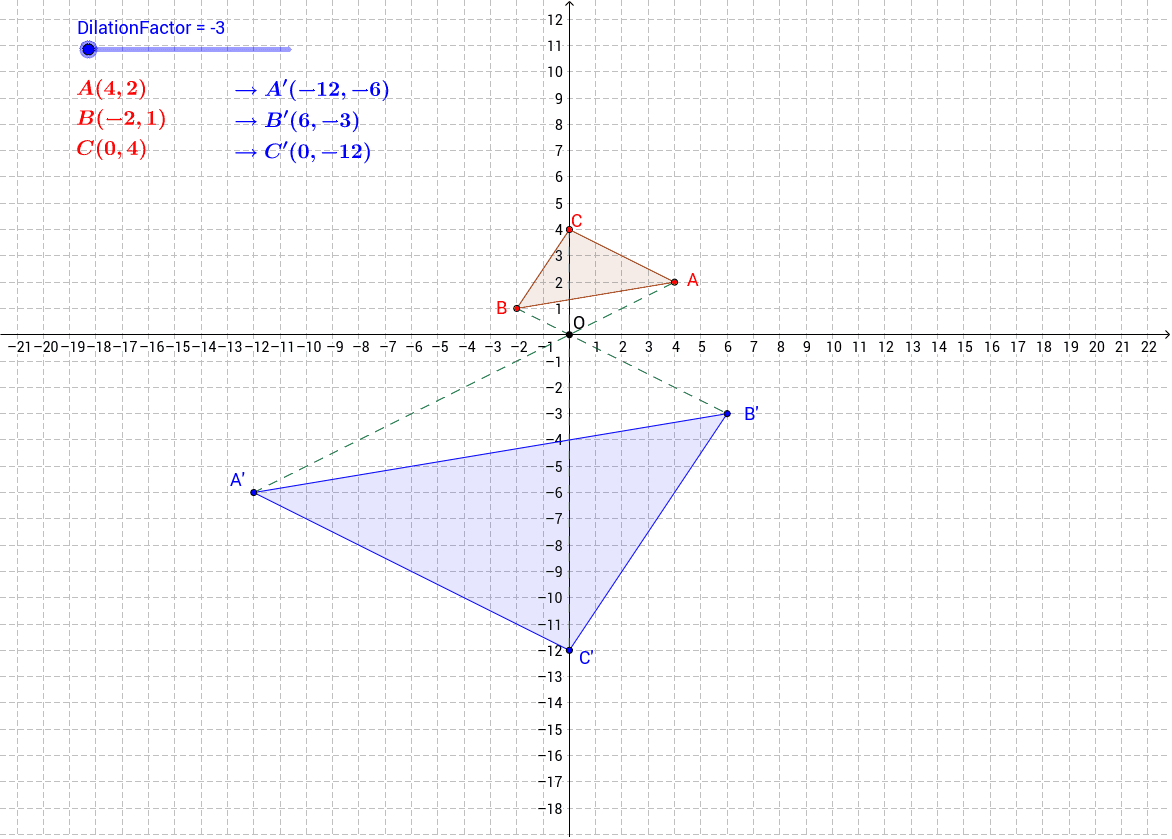
This example demonstrates the dilation of a triangle about the origin. By adjusting the dilation factor, students can observe the changes in the coordinates of the triangle vertices. Key mathematical concepts include similarity transformation and coordinate geometry. The example uses commands such as Intersect, Polygon, Dilate, and Segment. Suitable for middle school and above students to learn about similarity transformations.
GeoGebra Commands & Parameters
Intersect(xAxis, yAxis) → OPolygon(B, C, A) → poly1, d, b, cDilate(B, DilationFactor, O) → B'Dilate(C, DilationFactor, O) → C'Dilate(A, DilationFactor, O) → A'Polygon(B', C', A') → poly1', a', b', c'Segment(B, B') → aSegment(A', A) → eSegment(C, C') → f
AI Drawing Prompt Reference
Draw a triangle ABC, then perform a similarity transformation around the origin to observe changes in the coordinates of the triangle vertices. First, draw the intersection point O of the x-axis and y-axis, then draw triangle ABC. Adjust the dilation factor to dilate points A, B, and C to A', B', and C' respectively. Finally, draw the corresponding sides of the original and dilated triangles.
The prompt above was compiled from the original drawing commands and is for reference only.