
Diagonal of a Cube
Loading the math board and drawing, please wait…
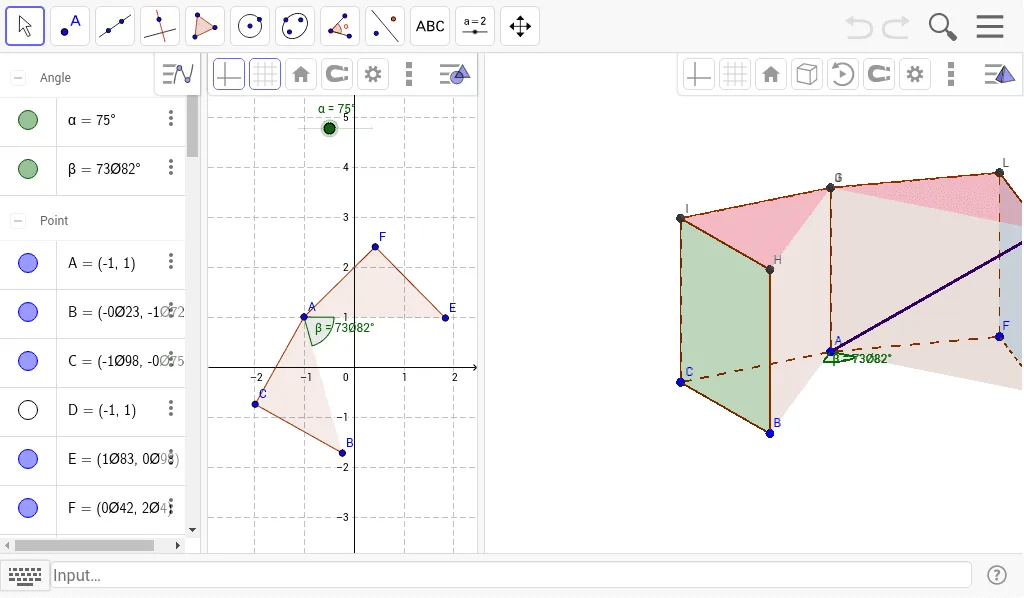
This example demonstrates the construction of a cube's diagonal. Key mathematical concepts include solid geometry and the calculation of diagonals. Using GeoGebra commands such as Point, Polygon, Prism, Segment, etc., the construction process of the cube is dynamically shown. Suitable for students at the junior high school level and above.
GeoGebra Commands & Parameters
Point(Circle[A, 2.8284271247461903]) → BPolygon(A, B, C) → poly1, c, a, bPoint(Circle[D, 2.8284271247461903]) → EPolygon(D, E, F) → poly2, f, d, ePrism(poly1, 2) → g, G, edgeCI, edgeGH, edgeHI, edgeGI, H, I, faceABHG, faceBCIH, faceACIG, faceGHI, edgeAG, edgeBHPrism(poly2, 2) → h, J, edgeFL, edgeJK, edgeKL, edgeJL, K, L, faceDEKJ, faceEFLK, faceDFLJ, faceJKL, edgeDJ, edgeEKSegment(D, K) → iAngle(B, A, E) → β
AI Drawing Prompt Reference
Draw a cube and its diagonal. Start by drawing a circle with center A and radius 2.828 to get point B, then connect points A, B, and C to form a triangle. Next, draw a circle with center D and radius 2.828 to get point E, then connect points D, E, and F to form another triangle. Extend the two triangles ABC and DEF upwards by 2 units to form two square faces. Finally, connect point D and point K to form one of the cube's diagonals.
The prompt above was compiled from the original drawing commands and is for reference only.