
Determining Similarity of Shapes
Loading the math board and drawing, please wait…
In collections
Obstar Dilation and Similarity Exploration
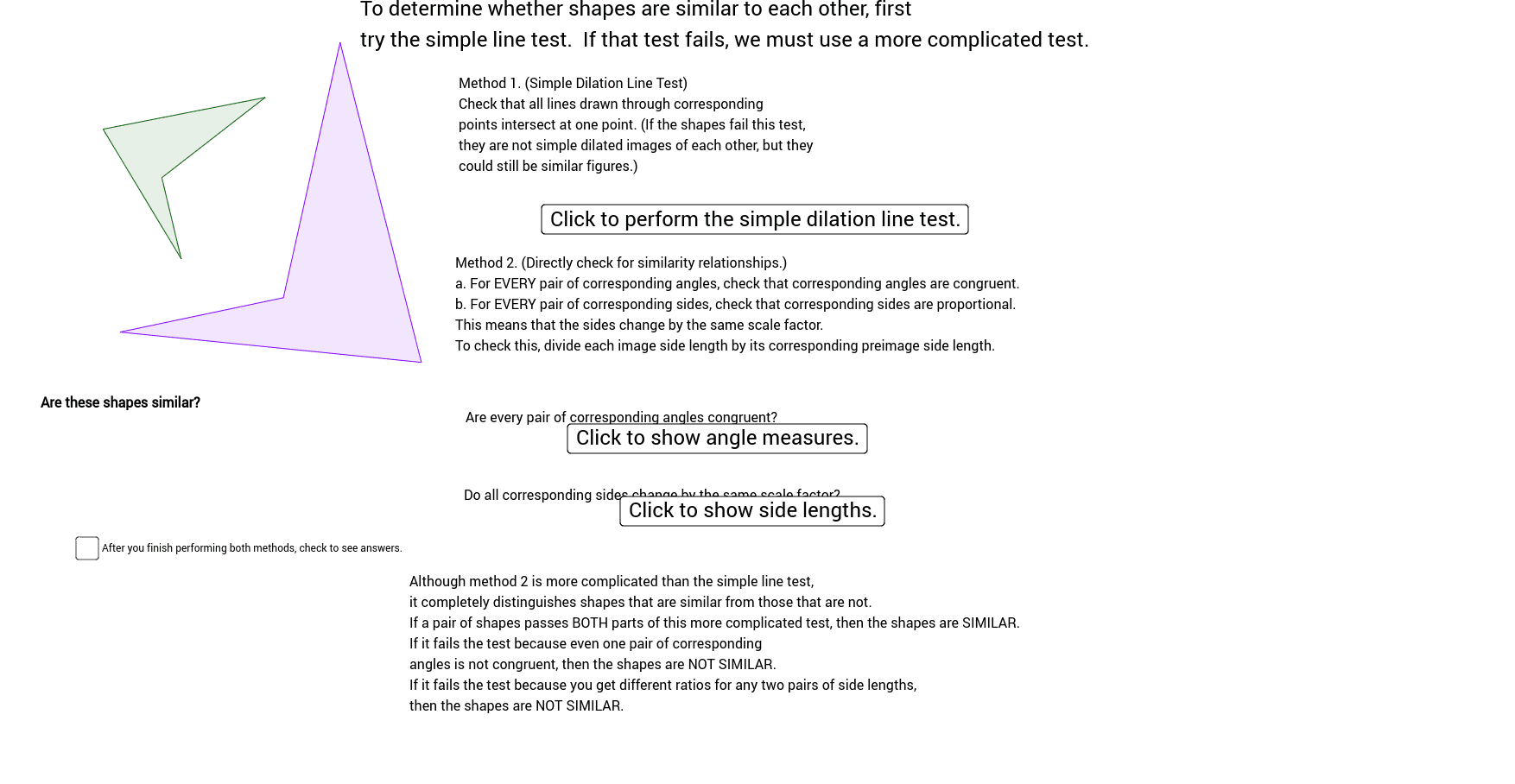
This example demonstrates how to determine if two polygons are similar through similarity transformations. Key math concepts include similarity criteria, geometric transformations (scaling, rotation, reflection), and relationships between angles and side lengths. Construction highlights involve using Polygon, Dilate, Line, Mirror, Angle, and Segment commands in GeoGebra. Suitable for high school students learning geometric similarity.
GeoGebra Commands & Parameters
Polygon(A, B, C, D) → poly1, a, b, c, dDilate(A, 2, E) → A'Dilate(B, 2, E) → B'Dilate(C, 2, E) → C'Dilate(D, 2, E) → D'Polygon(A', B', C', D') → poly1', a', b', c', d'Line(F, G) → eMirror(A', e) → A''Mirror(B', e) → B''Mirror(C', e) → C''Mirror(D', e) → D''Polygon(A'', B'', C'', D'') → poly1'', a'', b'', c'', d''Line(B, B'') → fLine(D'', D) → gLine(A'', A) → hLine(C'', C) → iAngle(C, B, A) → CBAAngle(D, C, B) → DCBAngle(A, D, C) → ADCAngle(B, A, D) → BADAngle(D'', A'', B'') → D'A'B'Angle(A'', B'', C'') → A'B'C'Angle(C'', D'', A'') → C'D'A'Angle(B'', C'', D'') → B'C'D'Segment(D, C) → jSegment(C, B) → kSegment(B, A) → lSegment(A, D) → mSegment(A'', D'') → nSegment(D'', C'') → pSegment(C'', B'') → qSegment(B'', A'') → r