
Determining if Two Shapes are Related by Dilation
Loading the math board and drawing, please wait…
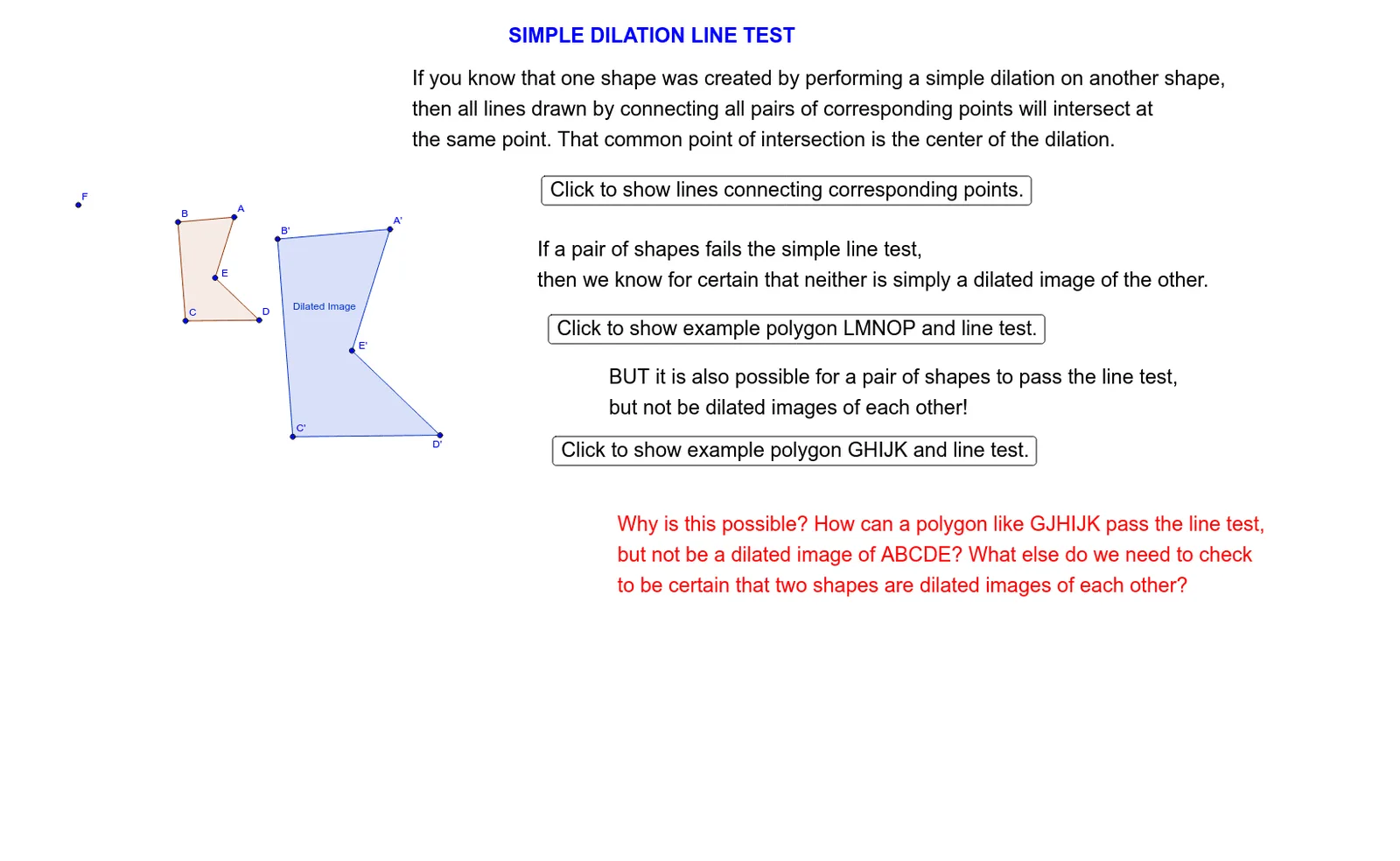
This example demonstrates how to determine if two polygons are related by dilation, involving core concepts like dilation, coordinate geometry, and similar figures. It uses commands such as Polygon, Dilate, Line, and Point with parameters a, b, c, d, e to construct and analyze the dilation transformation, suitable for high school students learning about properties of similarity transformations.
GeoGebra Commands & Parameters
Polygon(A, B, C, D, E) → poly1, a, b, c, d, eDilate(A, 2, F) → A'Dilate(B, 2, F) → B'Dilate(C, 2, F) → C'Dilate(D, 2, F) → D'Dilate(E, 2, F) → E'Polygon(A', B', C', D', E') → poly1', a', b', c', d', e'Line(C', C) → fLine(D', D) → kLine(E', E) → lLine(A', F) → mLine(B', F) → nPoint(n) → GPoint(m) → HPoint(l) → IPoint(k) → JPoint(f) → KPolygon(G, K, J, I, H) → poly3, g, k_1, j, i, hPolygon(L, M, N, O, P) → poly2, l_1, m_1, n_1, o, pLine(L, A) → qLine(M, B) → rLine(P, E) → sLine(O, D) → tLine(N, C) → u