
Determine if a Decimal is Repeating
Loading the math board and drawing, please wait…
In collections
Rational Numbers الأعداد النسبية
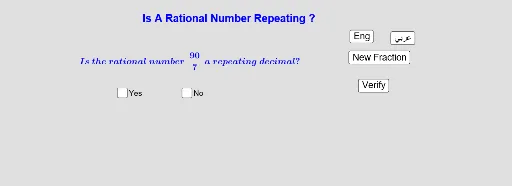
This example demonstrates how to determine if a number is a repeating decimal. Key mathematical concepts include the definition and properties of repeating decimals. Construction highlights include the use of GCD, Div, Mod, and other commands to identify the repeating cycle.
GeoGebra Commands & Parameters
GCD(a, b) → dRemoveUndefined(Sequence[If[Mod[b', k] ≟ 0, k, NaN], k, 2, b' - 1]) → FRemoveUndefined(Sequence[If[IsPrime[Element[F, k]], Element[F, k], NaN], k, 1, Length[F]]) → FPRemoveUndefined(Sequence[If[Element[FP, k] ≟ 2 ∨ Element[FP, k] ≟ 5, NaN, Element[FP, k]], k, 1, Length[FP]]) → PDiv(98, 19) → qMod(98, 19) → rIf(IsPrime[b'] ∧ b' ≠ 2 ∧ b' ≠ 5, true, false) → PVDiv(n1, 1) → n2
AI Drawing Prompt Reference
Draw the quotient and remainder of 98 divided by 19, and the process of checking if the remainder is a prime number and not equal to 2 or 5. First, calculate the quotient q and remainder r of 98 divided by 19, then check if r is a prime number and not equal to 2 or 5, and finally display q and r.
The prompt above was compiled from the original drawing commands and is for reference only.