
Descartes' Method for an Ellipse Tangent by Caroline Kuhn
Loading the math board and drawing, please wait…
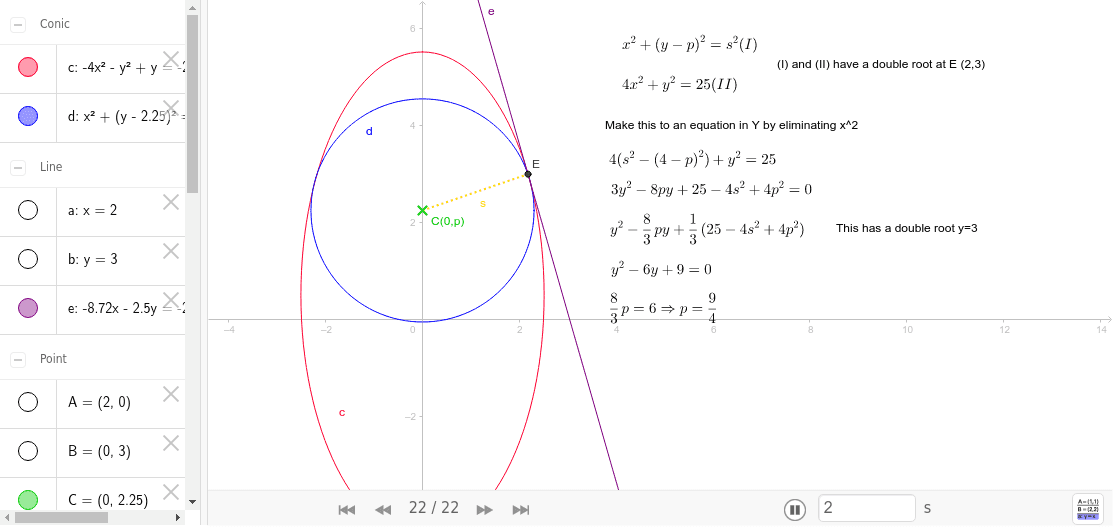
① This example demonstrates Descartes' geometric method for constructing the tangent line to an ellipse at a given point, showing how the normal (perpendicular) line helps determine the tangent direction. ② Core mathematical concepts include ellipse properties, tangents, normals, and early analytic geometry techniques, involving perpendicular lines, intersections, circles, and tangent constructions. ③ Construction details: Based on the summary, GeoGebra commands such as OrthogonalLine, Point, Intersect, Segment, Circle, and Tangent are used, creating objects like ellipse c, points A, B, C, and multiple text labels (text1 to text10) for annotations. ④ Suitable for high school or college analytic geometry courses, useful for understanding classical tangent construction methods and as a mathematics history resource illustrating Descartes' pre-calculus geometric approach.
GeoGebra Commands & Parameters
OrthogonalLine(A, xAxis) → aPoint(yAxis) → BOrthogonalLine(B, yAxis) → bIntersect(b, a) → C_1Intersect(c, b) → D, EPoint(yAxis) → CSegment(C, E) → sCircle(C, E) → dTangent(E, c) → e,
AI Drawing Prompt Reference
Draw an ellipse c and find its tangent at a given point A. Start by taking a point B on the y-axis of the ellipse c, then draw a perpendicular line b to B. Next, draw a perpendicular line a to point A on the x-axis, and let it intersect b at point C₁. Then, draw a line segment s and a circle d through C₁ and the intersection points D and E of b and the ellipse c. Finally, draw the tangent line e to the ellipse c at point E.
The prompt above was compiled from the original drawing commands and is for reference only.