
Descartes' Method for an Ellipse Tangent
Loading the math board and drawing, please wait…
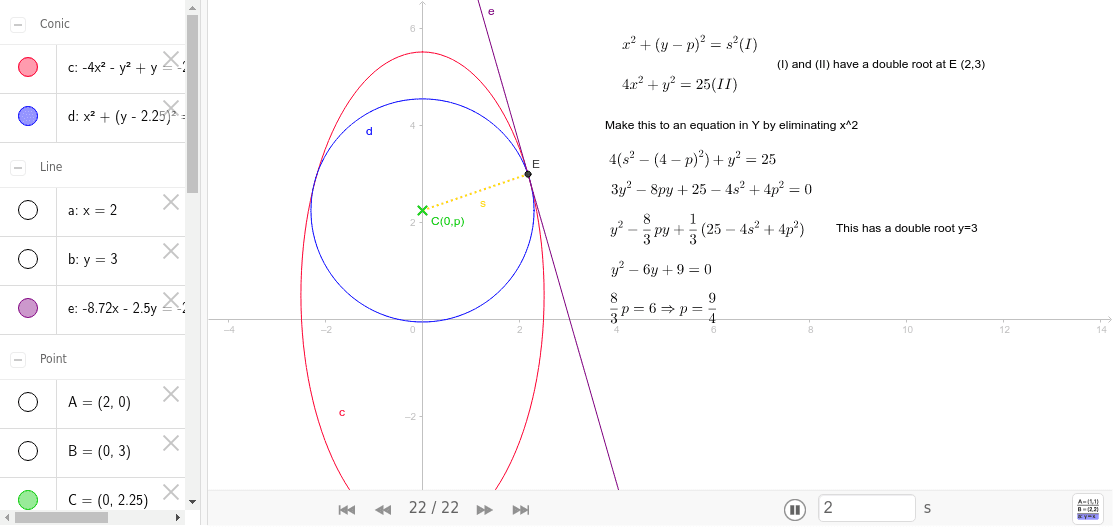
This example demonstrates Descartes' method for finding the tangent line to an ellipse, involving key math concepts like ellipses, vectors, derivatives, and coordinate geometry. It utilizes GeoGebra commands such as OrthogonalLine, Point, Intersect, Segment, Circle, and Tangent as outlined in the construction summary. Suitable for high school students and educators learning or teaching ellipse tangent calculation and geometric visualization.
GeoGebra Commands & Parameters
OrthogonalLine(A, xAxis) → aPoint(yAxis) → BOrthogonalLine(B, yAxis) → bIntersect(b, a) → C_1Intersect(c, b) → D, EPoint(yAxis) → CSegment(C, E) → sCircle(C, E) → dTangent(E, c) → e,
AI Drawing Prompt Reference
Draw an ellipse and show the construction of one of its tangent lines. First, draw the axes of symmetry of the ellipse and find a point on the horizontal axis. Then, draw a line perpendicular to the horizontal axis from this point, and another line perpendicular to the vertical axis from a point on the vertical axis. The intersection of these two lines gives a point on the ellipse. Connect this point to the other two intersection points to form a circle. Finally, draw a tangent line from the circle to the ellipse at the intersection point, demonstrating the relationship between the tangent and the ellipse.
The prompt above was compiled from the original drawing commands and is for reference only.