
Derivative from First Principles Demo
Loading the math board and drawing, please wait…
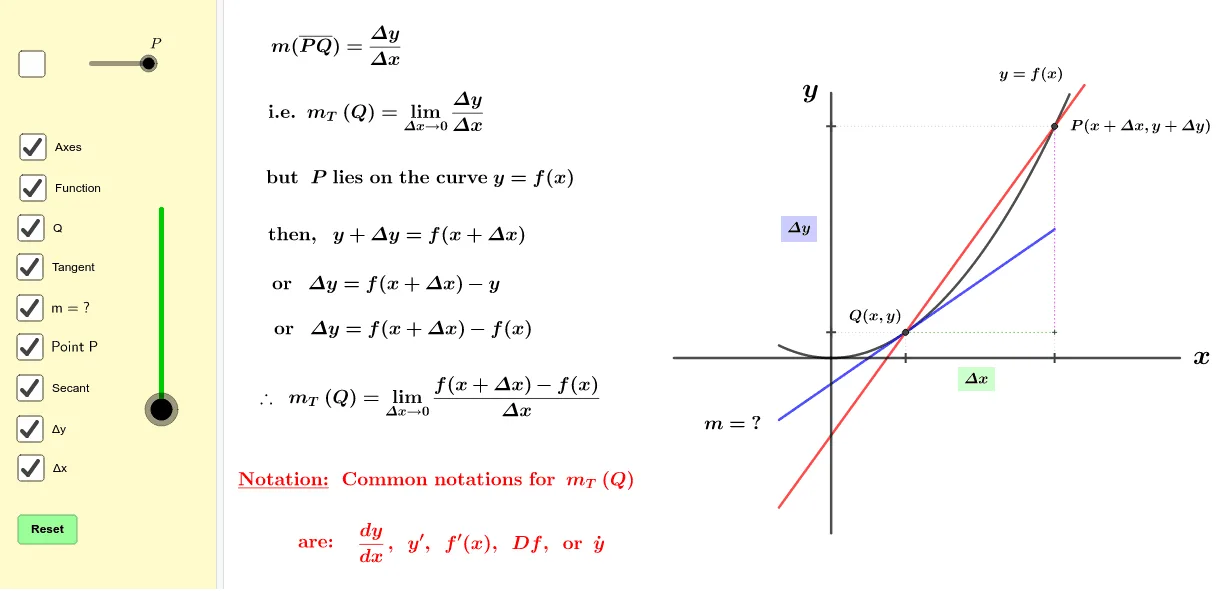
This example demonstrates the geometric meaning of a derivative at a point, showing how the slope of a tangent line relates to the function. Key math concepts include derivative definition, limit concept, function graph, and tangent slope. GeoGebra commands used are Sequence, OrthogonalLine, Intersect, Segment, Angle, Point, If, and Midpoint. Suitable for high school students and above learning introductory calculus or understanding the relationship between derivatives and function graphs.
GeoGebra Commands & Parameters
Sequence(u - x(A), u, b, q, -0.1) → ListOrthogonalLine(B, xAxis) → iIntersect(i, xAxis) → COrthogonalLine(A, xAxis) → jIntersect(j, xAxis) → DOrthogonalLine(B, yAxis) → kIntersect(k, yAxis) → FOrthogonalLine(A, yAxis) → lIntersect(l, yAxis) → EIntersect(i, l) → GSegment(B, C) → rSegment(A, D) → sSegment(G, E) → tSegment(B, F) → dAngle(G, A, B) → αSegment(A, G) → m_1Segment(B, G) → nPoint(xAxis) → HPoint(xAxis) → ISegment(H, I) → f_1Point(yAxis) → JPoint(yAxis) → KSegment(J, K) → g_1Segment(E, A) → h_1Sequence(f(z) - y(A), z, b, q, -0.1) → L_1If(q ≤ 3, Element[L_1, 1] + "", "") → C3If(q ≤ 2.9, Element[L_1, 2] + "", "") → C4If(q ≤ 2.8, Element[L_1, 3] + "", "") → C5If(q ≤ 2.7, Element[L_1, 4] + "", "") → C6If(q ≤ 2.6, Element[L_1, 5] + "", "") → C7If(q ≤ 2.5, Element[L_1, 6] + "", "") → C8If(q ≤ 2.4, Element[L_1, 7] + "", "") → C9If(q ≤ 2.3, Element[L_1, 8] + "", "") → C10If(q ≤ 2.2, Element[L_1, 9] + "", "") → C11If(q ≤ 2.1, Element[L_1, 10] + "", "") → C12If(q ≤ 2, Element[L_1, 11] + "", "") → C13If(q ≤ 1.9, Element[L_1, 12] + "", "") → C14If(q ≤ 1.8, Element[L_1, 13] + "", "") → C15If(q ≤ 1.7, Element[L_1, 14] + "", "") → C16If(q ≤ 1.6, Element[L_1, 15] + "", "") → C17If(q ≤ 1.5, Element[L_1, 16] + "", "") → C18If(q ≤ 1.4, Element[L_1, 17] + "", "") → C19If(q ≤ 1.3, Element[L_1, 18] + "", "") → C20If(q ≤ 1.2, Element[L_1, 19] + "", "") → C21If(q ≤ 1.1, Element[L_1, 20] + "", "") → C22If(q ≤ 3, Element[List, 1]) → H3If(q ≤ 2.9, Element[List, 2]) → H4If(q ≤ 2.8, Element[List, 3]) → H5If(q ≤ 2.7, Element[List, 4]) → H6If(q ≤ 2.6, Element[List, 5]) → H7If(q ≤ 2.5, Element[List, 6]) → H8If(q ≤ 2.4, Element[List, 7]) → H9If(q ≤ 2.3, Element[List, 8]) → H10If(q ≤ 2.2, Element[List, 9]) → H11If(q ≤ 2.1, Element[List, 10]) → H12If(q ≤ 2, Element[List, 11]) → H13If(q ≤ 1.9, Element[List, 12]) → H14If(q ≤ 1.8, Element[List, 13]) → H15If(q ≤ 1.7, Element[List, 14]) → H16If(q ≤ 1.6, Element[List, 15]) → H17If(q ≤ 1.5, Element[List, 16]) → H18If(q ≤ 1.4, Element[List, 17]) → H19If(q ≤ 1.3, Element[List, 18]) → H20If(q ≤ 1.2, Element[List, 19]) → H21If(q ≤ 1.1, Element[List, 20]) → H22If(q ≤ 3, Element[L_1, 1]) → I3If(q ≤ 2.9, Element[L_1, 2]) → I4If(q ≤ 2.8, Element[L_1, 3]) → I5If(q ≤ 2.7, Element[L_1, 4]) → I6If(q ≤ 2.6, Element[L_1, 5]) → I7If(q ≤ 2.5, Element[L_1, 6]) → I8If(q ≤ 2.4, Element[L_1, 7]) → I9If(q ≤ 2.3, Element[L_1, 8]) → I10If(q ≤ 2.2, Element[L_1, 9]) → I11If(q ≤ 2.1, Element[L_1, 10]) → I12If(q ≤ 2, Element[L_1, 11]) → I13If(q ≤ 1.9, Element[L_1, 12]) → I14If(q ≤ 1.8, Element[L_1, 13]) → I15If(q ≤ 1.7, Element[L_1, 14]) → I16If(q ≤ 1.6, Element[L_1, 15]) → I17If(q ≤ 1.5, Element[L_1, 16]) → I18If(q ≤ 1.4, Element[L_1, 17]) → I19If(q ≤ 1.3, Element[L_1, 18]) → I20If(q ≤ 1.2, Element[L_1, 19]) → I21If(q ≤ 1.1, Element[L_1, 20]) → I22If(q ≤ 2.3, I10 / H10 + "", "") → E10If(q ≤ 1.9, Element[List, 12] + "", "") → D14If(q ≤ 3, Element[List, 1] + "", "") → D3If(q ≤ 2.9, Element[List, 2] + "", "") → D4If(q ≤ 2.8, Element[List, 3] + "", "") → D5If(q ≤ 2.7, Element[List, 4] + "", "") → D6If(q ≤ 2.6, Element[List, 5] + "", "") → D7If(q ≤ 2.5, Element[List, 6] + "", "") → D8If(q ≤ 2.4, Element[List, 7] + "", "") → D9If(q ≤ 2.3, Element[List, 8] + "", "") → D10If(q ≤ 2.2, Element[List, 9] + "", "") → D11If(q ≤ 2.1, Element[List, 10] + "", "") → D12If(q ≤ 2, Element[List, 11] + "", "") → D13If(q ≤ 1.8, Element[List, 13] + "", "") → D15If(q ≤ 1.7, Element[List, 14] + "", "") → D16If(q ≤ 1.6, Element[List, 15] + "", "") → D17If(q ≤ 1.5, Element[List, 16] + "", "") → D18If(q ≤ 1.4, Element[List, 17] + "", "") → D19If(q ≤ 1.3, Element[List, 18] + "", "") → D20If(q ≤ 1.2, Element[List, 19] + "", "") → D21If(q ≤ 1.1, Element[List, 20] + "", "") → D22If(q ≤ 3, I3 / H3 + "", "") → E3If(q ≤ 2.9, I4 / H4 + "", "") → E4If(q ≤ 2.8, I5 / H5 + "", "") → E5If(q ≤ 2.7, I6 / H6 + "", "") → E6If(q ≤ 2.6, I7 / H7 + "", "") → E7If(q ≤ 2.5, I8 / H8 + "", "") → E8If(q ≤ 2.4, I9 / H9 + "", "") → E9If(q ≤ 2.2, I11 / H11 + "", "") → E11If(q ≤ 2.1, I12 / H12 + "", "") → E12If(q ≤ 2, I13 / H13 + "", "") → E13If(q ≤ 1.9, I14 / H14 + "", "") → E14If(q ≤ 1.8, I15 / H15 + "", "") → E15If(q ≤ 1.7, I16 / H16 + "", "") → E16If(q ≤ 1.6, I17 / H17 + "", "") → E17If(q ≤ 1.5, I18 / H18 + "", "") → E18If(q ≤ 1.4, I19 / H19 + "", "") → E19If(q ≤ 1.3, I20 / H20 + "", "") → E20If(q ≤ 1.2, I21 / H21 + "", "") → E21If(q ≤ 1.1, I22 / H22 + "", "") → E22If(q ≤ 1, Element[L_1, 21]) → I23If(q ≤ 1, Element[List, 21]) → H23If(q ≤ 1, Element[L_1, 21] + "", "") → C23If(q ≤ 1, Element[List, 21] + "", "") → D23If(q ≤ 1, I23 / H23 + "", "") → E23Midpoint(C, D) → LMidpoint(F, E) → NIntersect(k, i_1) → OIntersect(l, i_1) → PMidpoint(O, P) → RPoint(f) → T
AI Drawing Prompt Reference
Draw a function graph and demonstrate the geometric meaning of its derivative. Select a point on the function graph, draw the tangent line at that point, and display its slope. Also, use dynamically changing points to illustrate the derivative definition and limit concept, including parallel and perpendicular line segments to the x-axis, and their angle relationships.
The prompt above was compiled from the original drawing commands and is for reference only.