
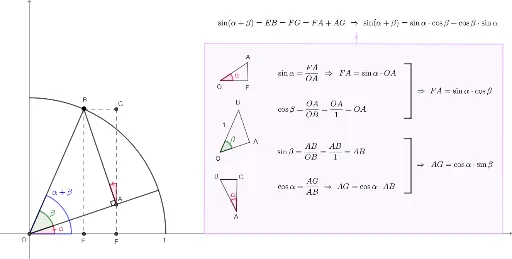
Demonstration of Sine of Angle Sum
Loading the math board and drawing, please wait…
This example dynamically illustrates the relationship between the sine of the sum of two angles and the individual sines of those angles. It involves core mathematical concepts such as trigonometric functions, angle sum formulas, and analytical geometry. Construction highlights include using GeoGebra commands like CurveCartesian for curves, Point for points, Intersect for intersections, Segment for segments, OrthogonalLine for perpendicular lines, Angle for angle measurement, Polygon for polygons, Line for lines, and Vector for vectors. It is suitable for high school mathematics students to learn and understand the properties of trigonometric functions, as well as for introductory calculus teaching.
GeoGebra Commands & Parameters
CurveCartesian(cos(t), sin(t), t, 0, π / 2) → aPoint(a) → A_1Point(a) → BIntersect(xAxis, yAxis) → OSegment(O, A_1) → fSegment(O, B) → gOrthogonalLine(B, f) → hIntersect(h, f) → AOrthogonalLine(B, xAxis) → iOrthogonalLine(A, xAxis) → jOrthogonalLine(B, j) → kIntersect(xAxis, i) → EIntersect(xAxis, j) → FIntersect(k, j) → GSegment(B, E) → lSegment(B, A) → mSegment(G, F) → nSegment(B, G) → pAngle(E, O, A) → αAngle(A, O, B) → βAngle(B, A, O) → γPolygon(C, I, H) → t1, h_1, c, dAngle(I, C, H) → δAngle(F, O, B) → εLine(L, f) → qLine(L, g) → rPoint(q) → MLine(M, m) → sIntersect(r, s) → NSegment(L, N) → tSegment(L, M) → bSegment(M, N) → eAngle(M, L, N) → ζSegment(P, Q) → f_1Segment(Q, R) → g_1Segment(S, R) → i_1Angle(G, A, B) → ηSegment(T, U) → j_1Segment(T, U) → k_1Segment(U, V) → l_1Segment(V, T) → m_1Angle(U, V, T) → θSegment(W, Z) → n_1Segment(C_1, B_1) → p_1Segment(Z, C_1) → q_1Point(xAxis) → F_1Point(xAxis) → G_1Polygon(D_1, E_1, F_1, G_1) → c1, d_1, e_1, r_1, s_1Point(d_1) → H_1Vector(H_1, I_1) → u