
Demonstration of Right and Oblique Pyramids
Loading the math board and drawing, please wait…
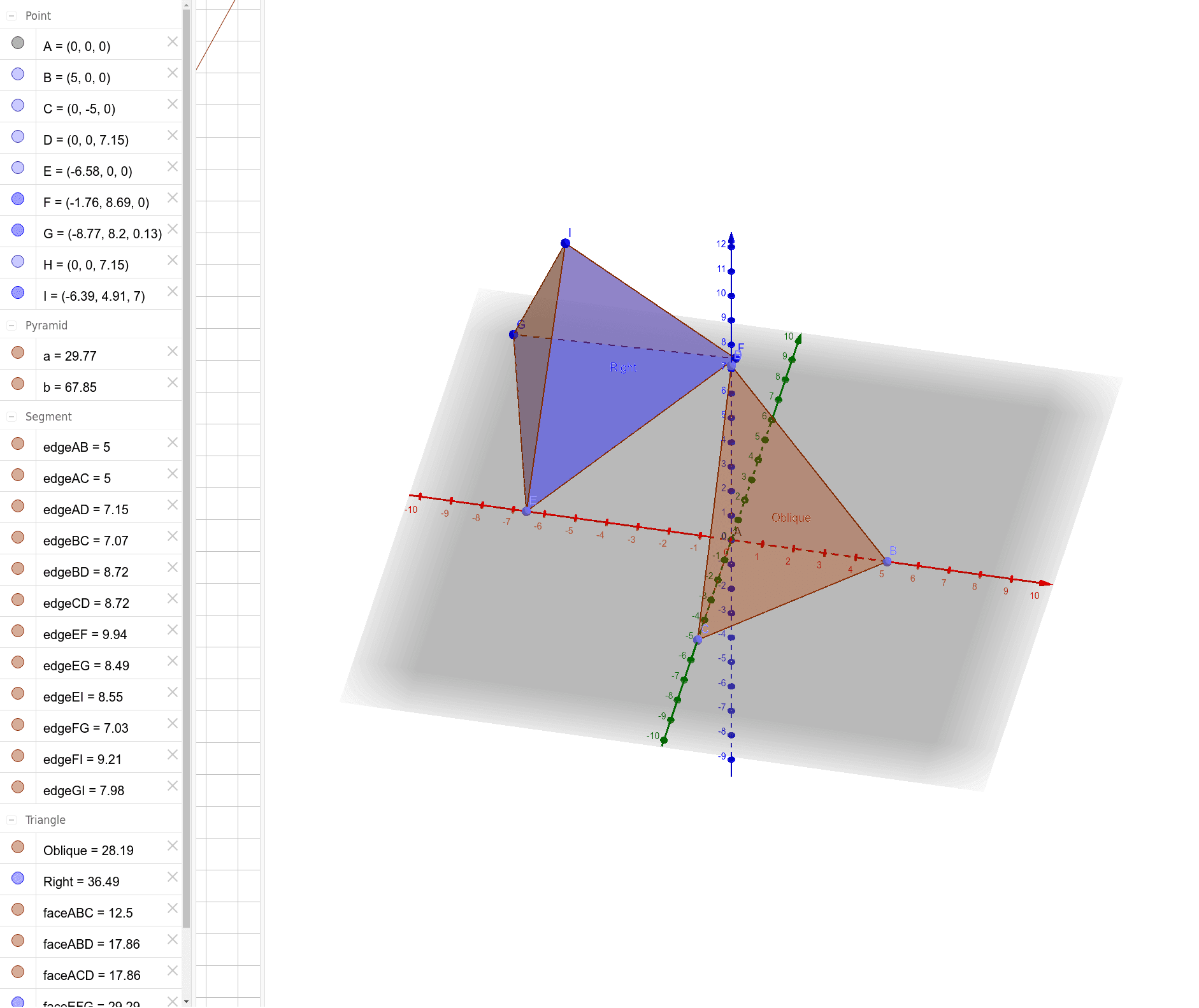
This example demonstrates the geometric construction and differences between right and oblique pyramids. The core math concepts involved include definitions of pyramids in solid geometry, relationships between faces and edges, and properties of spatial geometric bodies. The construction uses GeoGebra commands/objects such as Intersect (intersection), Point (points), and Pyramid (pyramid), with objects including A, B, C, D, a, faceABC, faceABD, Oblique, faceACD, edgeAB, edgeBC, edgeAC, edgeAD, edgeBD, edgeCD, H, E, F, G, I, b, faceEFG, Right, faceFGI, faceEGI, edgeEF, edgeFG, edgeEG, edgeEI, edgeFI, edgeGI. It is suitable for high school students learning solid geometry, helping them understand the structural characteristics and spatial relationships of different types of pyramids.
GeoGebra Commands & Parameters
Intersect(yAxis, xAxis) → APoint(xAxis) → BPoint(yAxis) → CPoint(zAxis) → DPyramid(A, B, C, D) → a, faceABC, edgeCD, faceABD, Oblique, faceACD, edgeAB, edgeBC, edgeAC, edgeAD, edgeBDPoint(edgeBD) → HPoint(xAxis) → EPyramid(E, F, G, I) → b, faceEFG, edgeGI, Right, faceFGI, faceEGI, edgeEF, edgeFG, edgeEG, edgeEI, edgeFI