
Decimal Conversion Practice
Loading the math board and drawing, please wait…
In collections
Wiederholung: Längen- und Flächenmaße
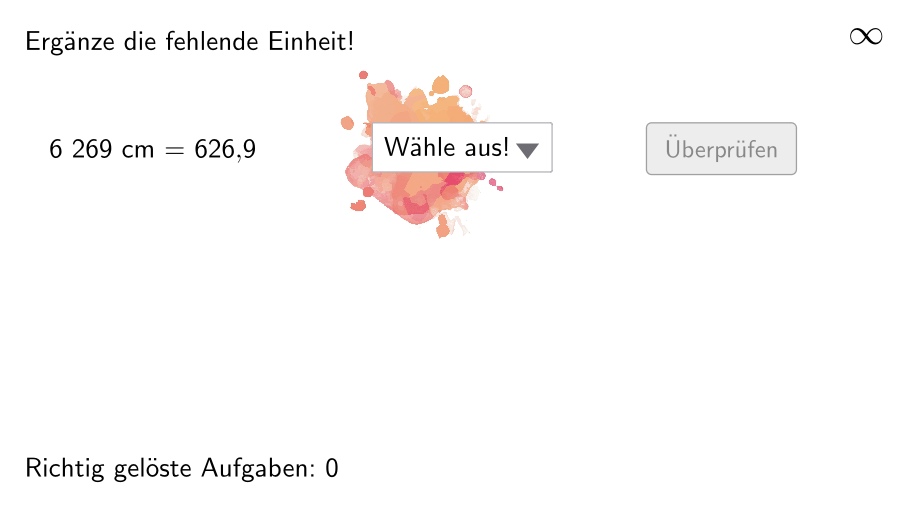
This example demonstrates the concept of decimal conversion, involving the core math concept of length unit conversion. Using GeoGebra commands such as Join, Element, If, etc., students can practice decimal conversion. Suitable for 5-6th grade students.
GeoGebra Commands & Parameters
Join(Sequence[Shuffle[{1, 2, 3, 4, 5, 6}], i, 1, 20]) → ListeBeispielCountElement(ListeBeispielCount, Mod[questionCount, 100]) → BeispielCountJoin(Sequence[Shuffle[{true, false}], i, 1, 50]) → ListeWWGroßAufKleinElement(ListeWWGroßAufKlein, Mod[questionCount, 100]) → großAufKleinIf(allowDecimalNumbers, Element[If[großAufKlein, ListeKommaGroßAufKlein, ListeKommaKleinAufGroß], BeispielCount], Element[If[großAufKlein, ListeGroßAufKlein, ListeKleinAufGroß], BeispielCount]) → BeispielElement(Beispiel, 2) → einheit2Join({{"$\textsf{Wähle aus!\vphantom{Öj}}$"}, {"$\textsf{mm\vphantom{Öj}}$", "$\textsf{\vphantom{Öj}cm}$", "$\textsf{dm\vphantom{Öj}}$", "$\textsf{m\vphantom{Öj}}$", "$\textsf{km\vphantom{Öj}}$"}}) → LLIndexOf(SelectedElement[LL], LL) → EinheitGewähltShuffle(Sequence[Random[111, 9999], i, 1, 100]) → randomNosForX, {5535, 6269, 4225, 4890, 9850, 6149, 9292, 8294, 5775, 2141, 7340, 5388, 2872, 9308, 6572, 5058, 3427, 3941, 1214, 3620, 1706, 3885, 1049, 6495, 6493, 6799, 4885, 6211, 8074, 121, 6455, 7618, 1421, 6311, 5187, 5556, 5788, 2005, 5322, 7445, 981, 647, 5513, 5268, 5595, 3521, 5703, 697, 1725, 6856, 3064, 2899, 5658, 4718, 6713, 4794, 7304, 2364, 2117, 8093, 4698, 2766, 9256, 9157, 5609, 3694, 824, 1995, 2006, 8287, 2926, 2861, 4785, 9625, 8117, 7187, 1493, 9522, 9370, 8521, 8917, 435, 8207, 9970, 3528, 2061, 5082, 3332, 2737, 9034, 8187, 9626, 7030, 7580, 5708, 1386, 2543, 3295, 7643, 3028}Append(true, Sequence[If[randomNosForX(i) ≟ randomNosForX(i - 1), false, true], i, 2, 100]) → stayXRemove(Sequence[If[stayX(i), randomNosForX(i), 0], i, 1, 100], Sequence[0, i, 1, 100]) → randomNosForXwithoutRepeatElement(randomNosForXwithoutRepeat, Mod[questionCount, Length[randomNosForXwithoutRepeat]] + 1) → numXwithoutRepeatElement(Beispiel, 1) → einheit1If(großAufKlein, Element[Beispiel, 4], 1 / Element[Beispiel, 4]) → faktorCorrectShuffle(Sequence[Random[1, 3], i, 1, 100]) → ListeFaktoren, {1, 2, 3, 3, 3, 2, 3, 1, 2, 3, 2, 1, 2, 1, 2, 1, 3, 2, 3, 1, 3, 2, 2, 3, 3, 3, 1, 1, 1, 2, 2, 1, 1, 1, 2, 1, 1, 1, 1, 1, 2, 3, 2, 1, 2, 3, 3, 3, 1, 1, 1, 1, 1, 2, 3, 2, 2, 2, 1, 1, 2, 2, 3, 3, 2, 2, 3, 2, 1, 1, 3, 3, 1, 1, 3, 3, 3, 1, 1, 1, 1, 2, 2, 3, 2, 3, 2, 2, 2, 3, 3, 2, 1, 1, 3, 1, 3, 1, 3, 2}Element(ListeFaktoren, Mod[questionCount, 100]) → positionFaktor0Element(Element[Beispiel, 3], positionFaktor0) → faktor0NumberSeperation(num) → NumSeperatedNumberSeperation(numCorrect) → TextNumCorrectTextfield(aInput) → InputBox1Textfield(bInput) → InputBox2Polygon(PtopLeftCornerFeedback, PtopRightCornerFeedback, PbottomRightCornerFeedback, PbottomLeftCornerFeedback) → rectangleCorrect, ptopleftcornerfeedback, ptoprightcornerfeedback, pbottomrightcornerfeedback, pbottomleftcornerfeedbackElement(randomNosForX, Mod[questionCount, 100] + 1) → numX
AI Drawing Prompt Reference
Draw a rectangular panel for a length unit conversion practice. Mark a unit-choice prompt that says to choose from mm, cm, dm, m, and km, and include a visible prompt text like “Wähle aus!”. Place two text input fields intended for the two numbers to convert. Use four corner points to define the rectangle and connect them in order to form the rectangle.
The prompt above was compiled from the original drawing commands and is for reference only.