
Day 4: Dilations (Part 3)
Loading the math board and drawing, please wait…
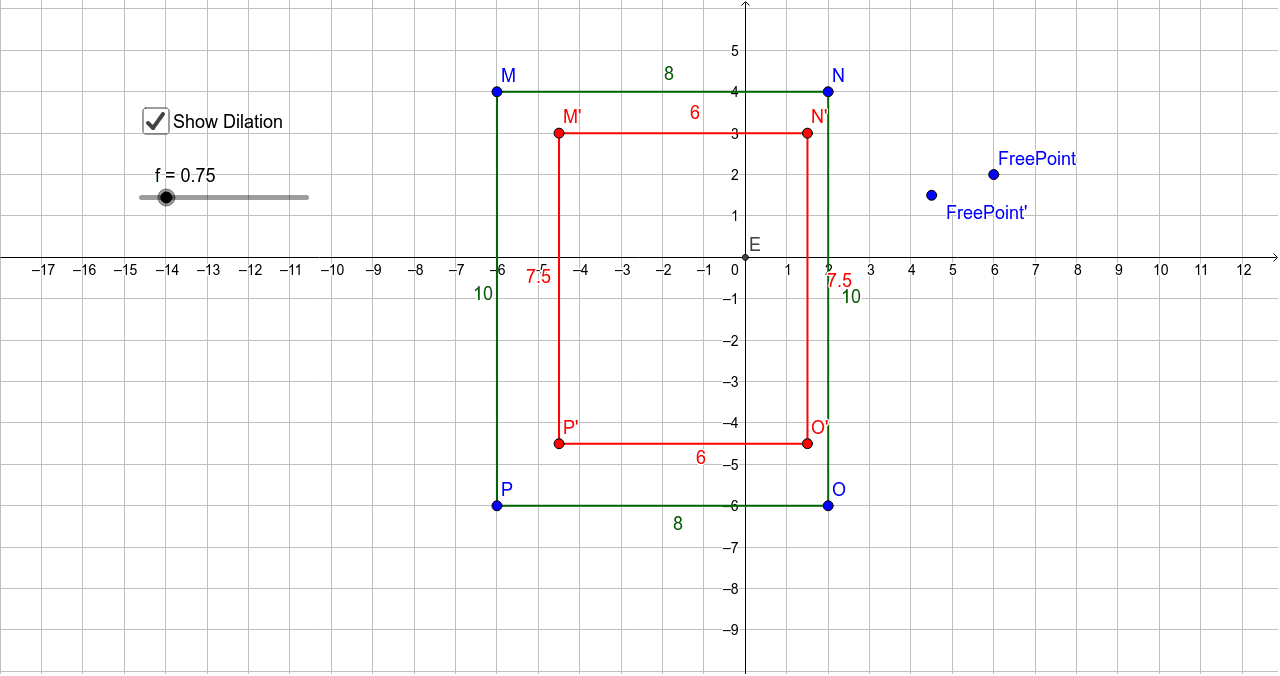
This example demonstrates how to use GeoGebra for dilation transformations and observe their effects. The core math concepts involved include dilation, expected value, arithmetic mean, exponential functions, parametric curves, and fractal geometry. Construction highlights involve using GeoGebra commands and objects like Intersect, Segment, and Dilate. Suitable for high school students learning about geometric transformations and function graphs.
GeoGebra Commands & Parameters
Intersect(xAxis, yAxis) → ESegment(M, N) → aSegment(O, P) → bSegment(N, O) → cSegment(P, M) → dDilate(M, f, E) → M'Dilate(N, f, E) → N'Segment(M', N') → a'Dilate(N, f, E) → B'_1Dilate(O, f, E) → O'Segment(B'_1, O') → c'Dilate(O, f, E) → C'_1Dilate(P, f, E) → P'Segment(C'_1, P') → b'Dilate(P, f, E) → D'_1Dilate(M, f, E) → A'_1Segment(D'_1, A'_1) → d'Dilate(FreePoint, f, E) → FreePoint'