
Dandelin's Theorem Demonstration
Loading the math board and drawing, please wait…
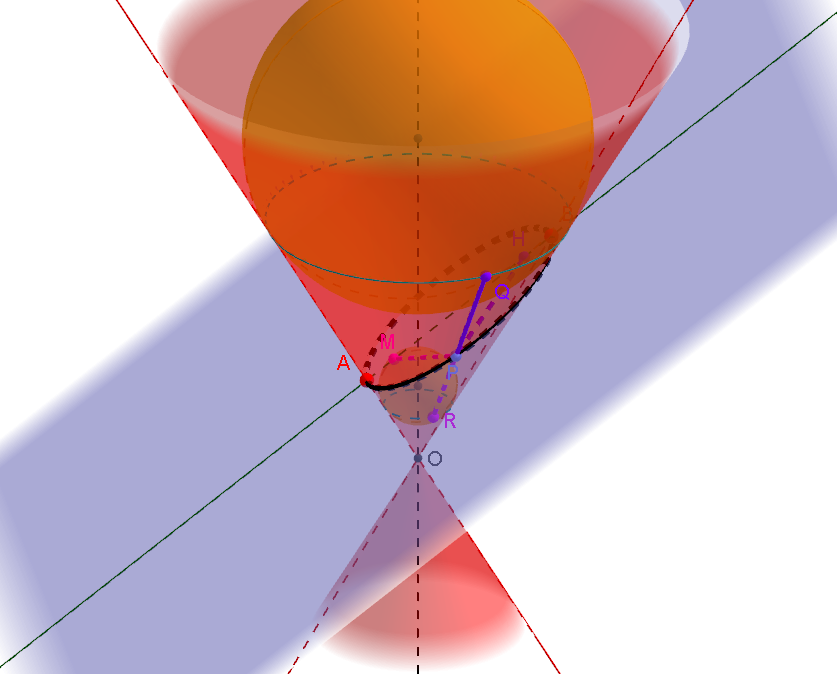
This example dynamically illustrates Dandelin's theorem, revealing the relationship between circles and conic sections in a cone; core math concepts include cones, angles, quadratic equations, and solid geometry; construction highlights involve commands/objects like ConeInfinite, Center, IntersectPath, Point, Axes, Plane, Vector, Angle, Rotate, Ray, Intersect, OrthogonalLine, Circle, Sphere, Line, Segment from GeoGebra; suitable for high school and above students studying solid geometry and conic sections.
GeoGebra Commands & Parameters
ConeInfinite((0, 0, 0), zAxis, 30*°) → aCenter(a) → OIntersectPath(k, a) → qPoint(q) → KAxes(a) → d, e, fPoint(Line[O, K]) → APoint(q) → FPoint(Line[O, F]) → BPlane(A, B_1, B) → bIntersectPath(b, a) → cAxes(c) → i, jVector(O, B) → vOBAngle(Vector[A, B], Vector[A, O]) → βVector(O, A) → vOARotate(vOA, β / 2, A, k) → vOA'Angle(Vector[B, A], Vector[O, B]) → αRotate(vOB, α / 2, B, k) → vOB'Ray(B, B') → gIntersect(f, g) → GOrthogonalLine(G, i, k) → hIntersect(i, h) → HCircle(G, H, k) → pSphere(G, H) → lIntersectIntersect(q, p, 3) → ICircle(f, I) → rRay(A, A') → mIntersect(f, m) → LOrthogonalLine(L, i, k) → nIntersect(i, n) → MCircle(L, M, k) → sIntersectIntersect(q, s, 1) → NSphere(L, N) → oPoint(c) → PCircle(f, N) → tLine(O, P) → a_1Intersect(a_1, r, 1) → QIntersect(a_1, t, 1) → RSegment(M, P) → b_1Segment(P, R) → c_1Segment(Q, P) → d_1Segment(P, H) → e_1Plane(M, R, P) → uIntersectPath(u, o) → f_1Plane(H, P, Q) → vIntersectPath(v, l) → g_1
AI Drawing Prompt Reference
Demonstrate Dandelin's theorem on an infinite cone. Start by drawing the cone's axis and a circle on its surface. From the cone's vertex, draw two tangents to the circle, connecting them to the circle's points of tangency. Form two intersecting planes using these points and the vertex. On these planes, draw circles intersecting the cone, marking their centers and intersection points. Finally, draw the lines of intersection between these circles and the cone, along with relevant auxiliary lines and angles, to reveal the relationship between the cone, circles, and conic sections.
The prompt above was compiled from the original drawing commands and is for reference only.