
Cyclic Quadrilateral by dsyddall
Loading the math board and drawing, please wait…
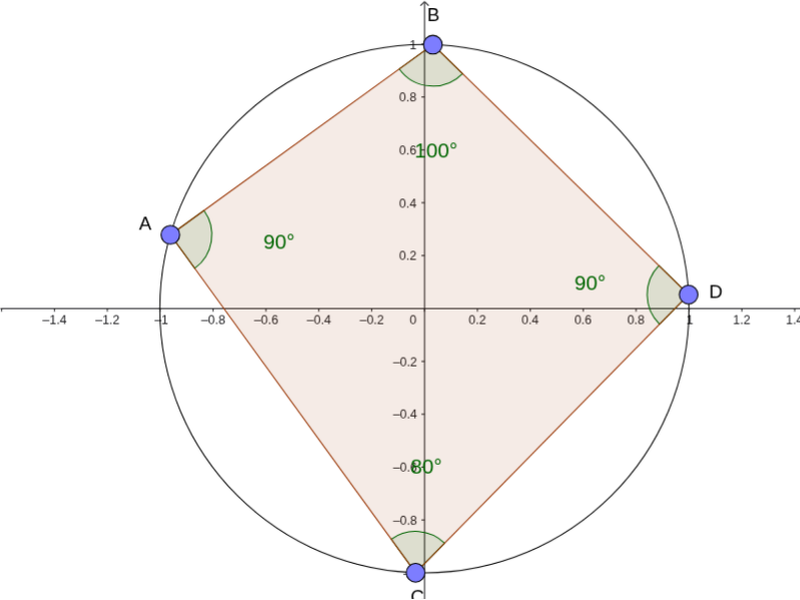
This example demonstrates the geometric properties of a cyclic quadrilateral, focusing on its angle relationships. Core mathematical concepts involved include circles, quadrilaterals, angles, secant lines, and trigonometric functions such as cosine. Construction uses GeoGebra commands like Intersect to find intersections, Circle to draw circles, Point to create points, Polygon to construct polygons, Segment to draw segments, Angle to measure angles, and Vector to add vectors. Objects include the center O, circle c, points A, B, C, etc., for building the figure. Suitable for high school mathematics, particularly in geometry and trigonometry, for teaching or self-study.
GeoGebra Commands & Parameters
Intersect(xAxis, yAxis) → OCircle(O, 1) → cPoint(c) → APoint(c) → CPoint(c) → BPolygon(A, C, B) → poly1, e, c_1, dSegment(C, O) → b_1Segment(O, B) → gAngle(O, A, B) → bAngle(A, B, O) → b_2Angle(C, A, B) → circAngle(C, O, B) → smallcentreAngle(C, O, B) → bigcentrePoint(c) → FAngle(F, O, C) → cangleAngle(F, O, B) → bangleAngle(F, O, A) → aangleAngle(C, B, O) → isosceles1Vector(A, O) → uVector(B, O) → vVector(C, O) → wAngle(B, C, O) → isosceles2Angle(B, C, A) → isoscelespluscircAngle(A, C, O) → αAngle(A, B, C) → βPoint(c) → EPolygon(B, E, C) → poly2, c_2, b_3, e_1Angle(F, O, E) → eangleAngle(B, E, C) → δPolygon(A, B, E, C) → poly3, a, b_4, e_2, c_3Angle(B, A, C) → γAngle(B, E, C) → εAngle(E, B, A) → ζAngle(E, C, A) → ηVector(E, O) → z