
Curve Stitching, Point Map: Modular and GCD-Driven Geometric Patterns
Loading the math board and drawing, please wait…
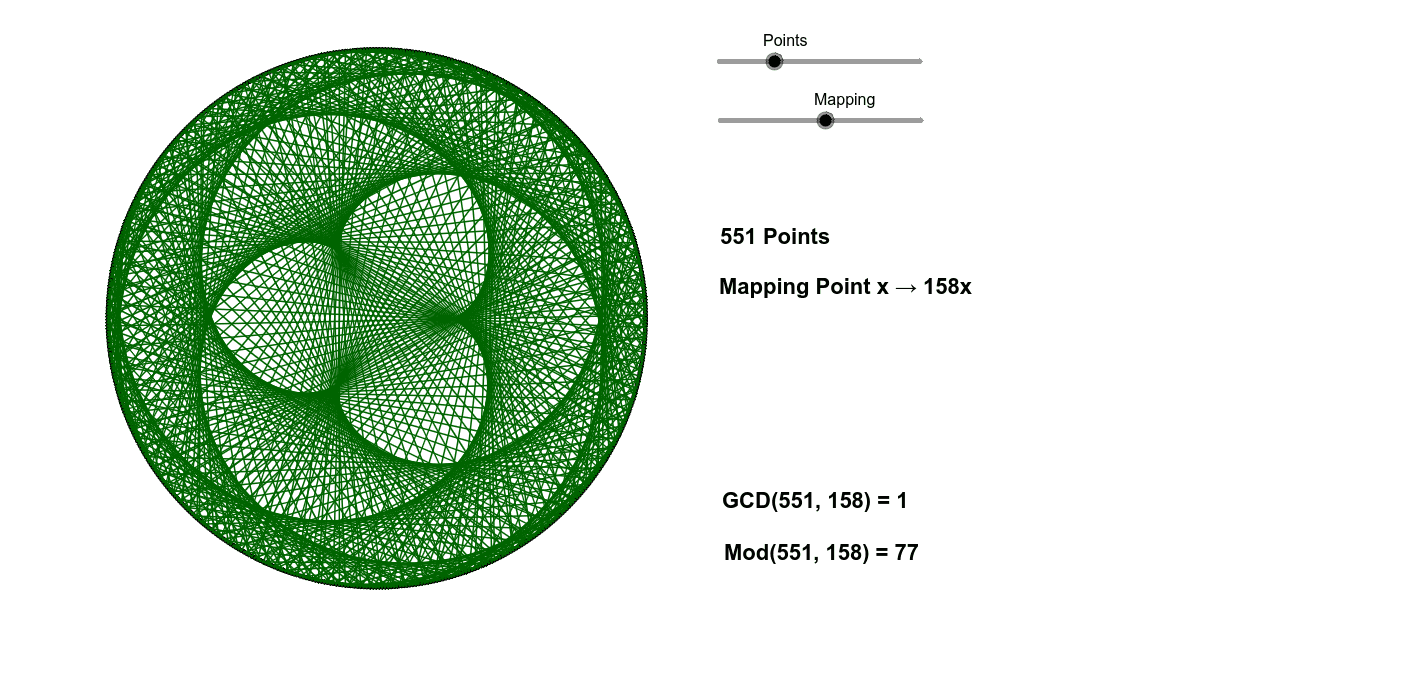
① This example demonstrates how to generate a curve stitching (string art) pattern by mapping points on a plane using modular arithmetic and greatest common divisor operations, visualizing the interplay between number theory and geometry. ② Core mathematical concepts include modular arithmetic (Mod), greatest common divisor (GCD), sequence generation (Sequence), and coordinate mapping of points, bridging discrete mathematics and coordinate geometry. ③ Construction highlights: The GeoGebra commands Sequence, Mod, and GCD are used to define point positions or connection rules, creating numerous point objects (A1–A23, B1–B10) that form the stitching-like pattern. ④ Suitable for high school or early college students, this example serves as an engaging introduction to number-theoretic patterns in visual form, and can be used in math-art projects or computational thinking exercises.
GeoGebra Commands & Parameters
Sequence(((5 * cos(a)), (5 * sin(a))), a, 0, (2 * π), (2 * π / n)) → list1Mod(A1, 5) → B1Mod(A2, 5) → B2Mod(A3, 5) → B3Mod(A4, 5) → B4Mod(A5, 5) → B5Mod(A6, 5) → B6Mod(A7, 5) → B7Mod(A8, 5) → B8Mod(A9, 5) → B9Mod(A10, 5) → B10Mod(A11, 5) → B11Mod(A12, 5) → B12Mod(A13, 5) → B13Mod(A14, 5) → B14Mod(A15, 5) → B15Mod(A16, 5) → B16Mod(A17, 5) → B17Mod(A18, 5) → B18Mod(A19, 5) → B19Mod(A20, 5) → B20Mod(A21, 5) → B21Mod(A22, 5) → B22Sequence(Segment[Element[list1, k], Element[list1, Mod[(m * k), n] + (n * floor((n - Mod[(m * k), n]) / n))]], k, 1, n) → list2GCD(m, n) → dMod(n, m) → e
AI Drawing Prompt Reference
Draw a curve stitching pattern on a plane by connecting points whose positions are determined by modular arithmetic and greatest common divisor operations. Start by generating a set of points on a circle centered at the origin with radius 5, then map these points to new positions using modular arithmetic. Finally, connect the original and mapped points with line segments to create a complex geometric pattern, illustrating the interplay between number theory and geometry.
The prompt above was compiled from the original drawing commands and is for reference only.