
Cube to Truncated Cube and Cubo Transformation
Loading the math board and drawing, please wait…
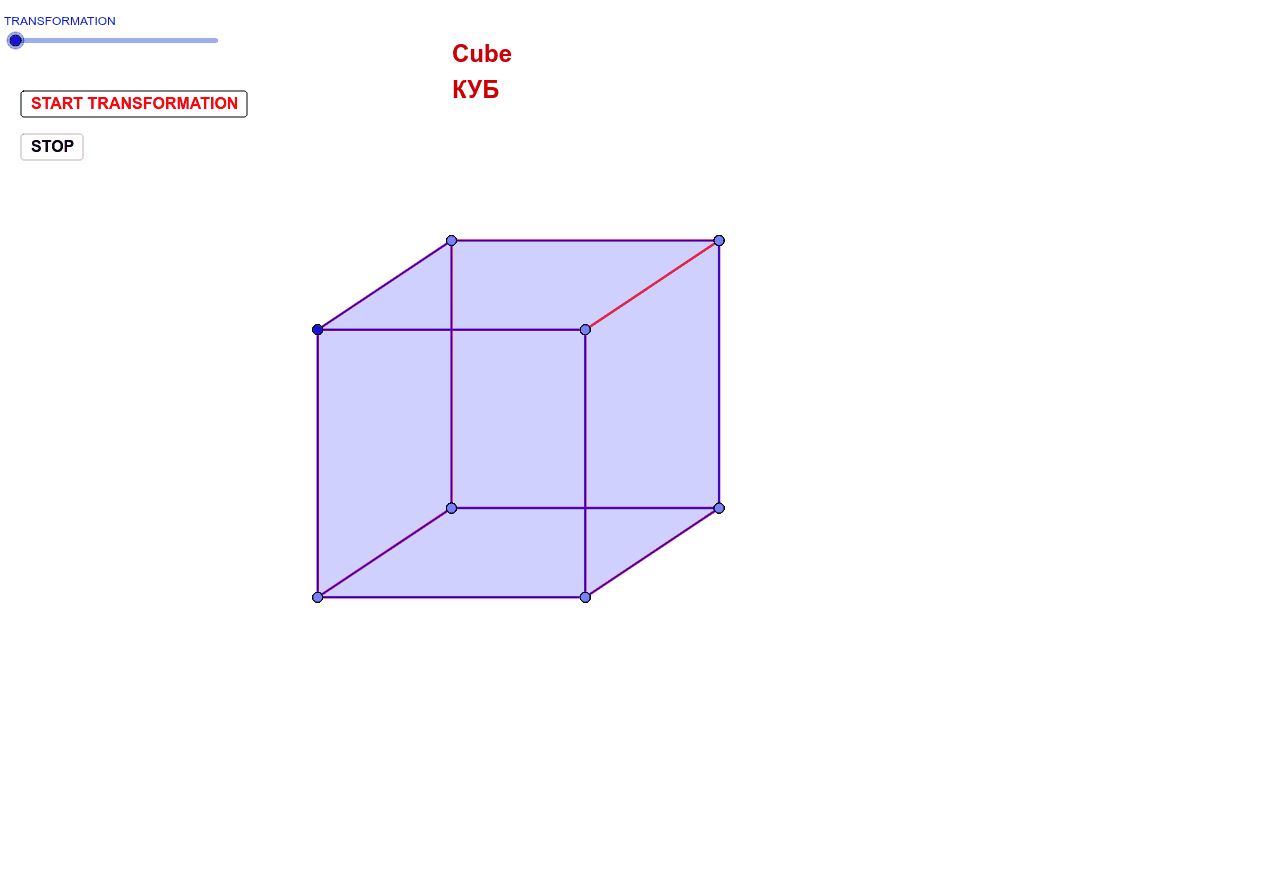
This GeoGebra example demonstrates a transformation from a cube to a truncated cube and a related cubo polyhedron. It involves solid geometry, polyhedra, vertices, edges, faces, truncation, vector translation, and coordinate-based construction. The construction uses Point to define vertices such as A, B, D, E, F, G, and H, Vector and Translate to generate transformed objects like A′, B′, D′, and F′, and Polygon, PolyLine, and Segment to draw edges and faces. Lists such as list1 and list2 help organize vertex sequences, while poly1 and poly2 represent constructed polygonal structures. It is suitable for secondary or undergraduate geometry teaching, spatial visualization, and GeoGebra 3D modeling examples.
GeoGebra Commands & Parameters
Vector(H, G) → uTranslate(A, u) → A'Translate(D, Vector[(-u)]) → D'Translate(F, Vector[(-u)]) → F'Translate(B, u) → B'Vector(H, M) → vTranslate(A, v) → A'_1Translate(B, Vector[(-v)]) → B'_1Translate(D, v) → D'_1Translate(F, Vector[(-v)]) → F'_1Polygon(D'_1, F'_1, F', B', B'_1, A'_1, A', D') → poly1, d'_1, f'_1, f', b', b'_1, a'_1, a', d'Translate(D, w) → D'_2Translate(E, Vector[(-w)]) → E'Polygon(D'_2, D'_1, D') → poly2, d'_2, d'_3, d'_4Translate({E, K}, v) → list1Translate({I, J}, Vector[(-v)]) → list2Translate({A, B, F}, w) → list3Translate({K, J, I}, Vector[(-w)]) → list4Point(list1) → LPoint(list2) → NPoint(list4) → OPoint(list3) → PPolygon(D'_2, E', L, N, O, P, F'_1, D'_1) → poly3, d'_5, e', l, n, o, p, f'_2, d'_6Point(list3) → QPoint(list4) → RPolygon(F'_1, P, F') → poly4, f'_3, f'_4, p_1Translate({K, B, J}, u) → list5Translate({E, I, F}, Vector[(-u)]) → list6Point(list5) → SPoint(list6) → TPolygon(B', Q, R, S, T, O, P, F') → poly5, b'_2, q_1, r, s, t, o_1, p_2, f'_5Polygon(B'_1, B', Q) → poly6, q_2, b'_3, b'_4Polygon(N, O, T) → poly9, t_1, n_1, o_2PolyLine(D, F, B, A, K, E) → aPolyLine(A, D, E, I, J, B) → bSegment(J, K) → cSegment(F, I) → dPoint(list6) → CPolygon(E', L, C) → poly7, c_1, e'_1, l_1Point(list5) → UPoint(list4) → VPoint(list1) → WPolygon(U, V, W) → poly8, w_1, u_1, v_1Point(list2) → ZPolygon(Z, R, S) → poly10, s_1, z_1, r_1Point(list3) → A_1Polygon(A', A_1, A'_1) → poly11, a'_2, a'_3, a_1Polygon(D'_2, E', C, U, V, A_1, A', D') → poly12, d'_7, e'_2, c_2, u_2, v_2, a_2, a'_4, d'_8Polygon(C, L, N, T, S, Z, W, U) → poly13, c_3, l_2, n_2, t_2, s_2, z_2, w_2, u_3Polygon(V, W, Z, R, Q, B'_1, A'_1, A_1) → poly14, v_3, w_3, z_3, r_2, q_3, b'_5, a'_5, a_3
AI Drawing Prompt Reference
Draw a cube and transform it into a truncated cube and related polyhedra by translating specific vertices using vectors. Show the changes in vertices, edges, and faces, using polygon tools to create shapes. Demonstrate geometric construction through vector translation and coordinate-based transformations, resulting in a complex structure of a truncated cube and cubo transformation.
The prompt above was compiled from the original drawing commands and is for reference only.