
Cube in Perspective
Loading the math board and drawing, please wait…
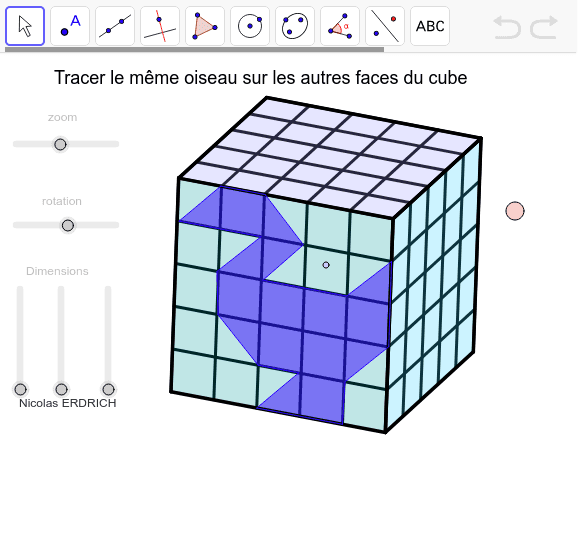
This example demonstrates the perspective projection of a cube in 3D space. It involves core mathematical concepts like trigonometry, exponential functions, indefinite integral, parabola, and Pythagorean theorem. Construction highlights include commands and objects such as Sequence, Element, Polygon, Segment, Translate, and Point from GeoGebra. Suitable for high school and above students learning solid geometry, spatial transformations, calculus, and analytical geometry.
GeoGebra Commands & Parameters
Sequence(Mat * Element[cube, k], k, 1, 8) → cube'Sequence(I + (Element[cube', k, 1, 1], Element[cube', k, 2, 1]), k, 1, 8) → listepointsElement(listepoints, 7) → FElement(listepoints, 6) → B_3Element(listepoints, 1) → EElement(listepoints, 2) → AElement(Element[AE, 3], 1) → droiteElement(listepoints, 4) → C_1Element(listepoints, 3) → DPolygon(A, E, C_1, D) → poly1, a_1, b, c_1, dElement(listepoints, 8) → GElement(listepoints, 5) → HPolygon(B_3, F, G, H) → poly2, e, f, g, hElement(listepoints, 3) → CPolygon(F, C, A, B_3) → poly3, f_1, i, a_2, b_1Element(AB, 3, 1) → avantPolygon(C_1, G, H, E) → poly4, c_2, g_1, h_1, e_1Element(AC, 3, 1) → dessusPolygon(F, C, C_1, G) → poly5, f_2, c_3, c_4, g_2Polygon(A, B_3, H, E) → poly6, a_3, b_2, h_2, e_2Segment(E, A) → cSegment(A, C) → jSegment(A, B_3) → kSegment(C, C_1) → lSegment(C_1, E) → mSegment(A, B_3) → pSegment(B_3, H) → qSegment(H, E) → rSegment(H, G) → sSegment(B_3, F) → tSegment(G, C_1) → d_1Segment(F, G) → i_1Segment(F, C) → j_1Polygon(A, B_3, F', D') → poly7, a_4, b_3, f', d'Polygon(E, A, D'', C') → poly8, e_3, a_5, d'', c'Polygon(B_3, F'', G', H) → poly9, b_4, f'', g', h_3Sequence(E + (A - E) * k / m_1, k, 0, m_1) → l_2Sequence(A + (B_3 - A) * k / k_1, k, 0, k_1) → l_1Sequence(H + (E - H) * k / k_1, k, 0, k_1) → l_4Sequence(B_3 + (H - B_3) * k / m_1, k, 0, m_1) → l_5Sequence(Segment[Element[l_1, k], Element[l_4, k_1 - k + 2]], k, 0, k_1) → s_1Sequence(G + (C_1 - G) * k / k_1, k, 0, k_1) → l_6Sequence(H + (G - H) * k / n_1, k, 0, n_1) → l_7Sequence(E + (C_1 - E) * k / n_1, k, 0, n_1) → l_8Sequence(Segment[Element[l_4, k], Element[l_6, k]], k, 0, k_1) → s_4Sequence(D + (C_1 - D) * k / m_1, k, 0, m_1) → l_9Sequence(D + (A - D) * k / n_1, k, 0, n_1) → l_{10}Sequence(B_3 + (F - B_3) * k / n_1, k, 0, n_1) → l_{12}Sequence(D + (F - D) * k / k_1, k, 0, k_1) → l_{11}Sequence(Segment[Element[l_{11}, k], Element[l_6, k_1 - k + 2]], k, 0, k_1) → s_7Sequence(Segment[Element[l_{11}, k], Element[l_1, k]], k, 0, k_1) → s_8Sequence(G + (F - G) * k / m_1, k, 0, m_1) → l_{13}Sequence(Segment[Element[l_2, k], Element[l_5, m_1 - k + 2]], k, 0, m_1) → s_2Sequence(Segment[Element[l_9, k], Element[l_2, m_1 - k + 2]], k, 0, m_1) → s_6Sequence(Segment[Element[l_{13}, k], Element[l_9, m_1 - k + 2]], k, 0, m_1) → s_{12}Sequence(Segment[Element[l_{13}, k], Element[l_5, m_1 - k + 2]], k, 0, m_1) → s_{11}Sequence(Segment[Element[l_{12}, k], Element[l_{10}, n_1 - k + 2]], k, 0, n_1) → s_9Sequence(Segment[Element[l_{12}, k], Element[l_7, k]], k, 0, n_1) → s_{10}Sequence(Segment[Element[l_7, k], Element[l_8, k]], k, 0, n_1) → s_3Sequence(Segment[Element[l_8, k], Element[l_{10}, n_1 - k + 2]], k, 0, n_1) → s_5Translate(A, Vector[A, J]) → U_ATranslate(U_A, Vector[1 / n_1 * Vector[A, C]]) → U_CTranslate(U_A, Vector[1 / k_1 * Vector[A, B_3]]) → U_BTranslate(U_B, Vector[1 / n_1 * Vector[A, C]]) → U_FTranslate(U_A, Vector[1 / m_1 * Vector[A, E]]) → U_ETranslate(U_E, Vector[1 / n_1 * Vector[E, C_1]]) → U_C1Translate(U_C1, Vector[1 / k_1 * Vector[C_1, G]]) → U_GTranslate(U_E, Vector[1 / k_1 * Vector[E, H]]) → U_HPoint(s_9) → BPoint(s_9) → KPoint(s_9) → LPoint(s_9) → MPoint(s_9) → NPoint(s_9) → OPoint(s_9) → QPoint(s_9) → RPoint(s_8) → SPoint(s_9) → VPoint(s_9) → TPoint(s_{10}) → WPoint(s_8) → UPoint(s_9) → ZPoint(s_9) → D_1Point(s_9) → E_1Polygon(B, K, S, R, Z, Q, O, E_1, L, M, N, D_1, T, W, V, U) → poly18, b_6, u_{15}, s_{13}, r_1, z_1, q_1, o_1, e_5, k_2, l_3, m_2, n_2, d_2, t_1, w_1, v_1
AI Drawing Prompt Reference
Draw a perspective projection of a cube in 3D space, highlighting its geometric construction. The cube consists of multiple faces, each a quadrilateral, connected by edges and vertices. Start by forming the basic shape of the cube, then use lines to connect the vertices to create a perspective effect. Emphasize key points, edges, and faces to observe the perspective transformation. The final image should clearly show the cube's 3D structure and perspective projection.
The prompt above was compiled from the original drawing commands and is for reference only.