
Cube and Cuboid Volume Calculation
Loading the math board and drawing, please wait…
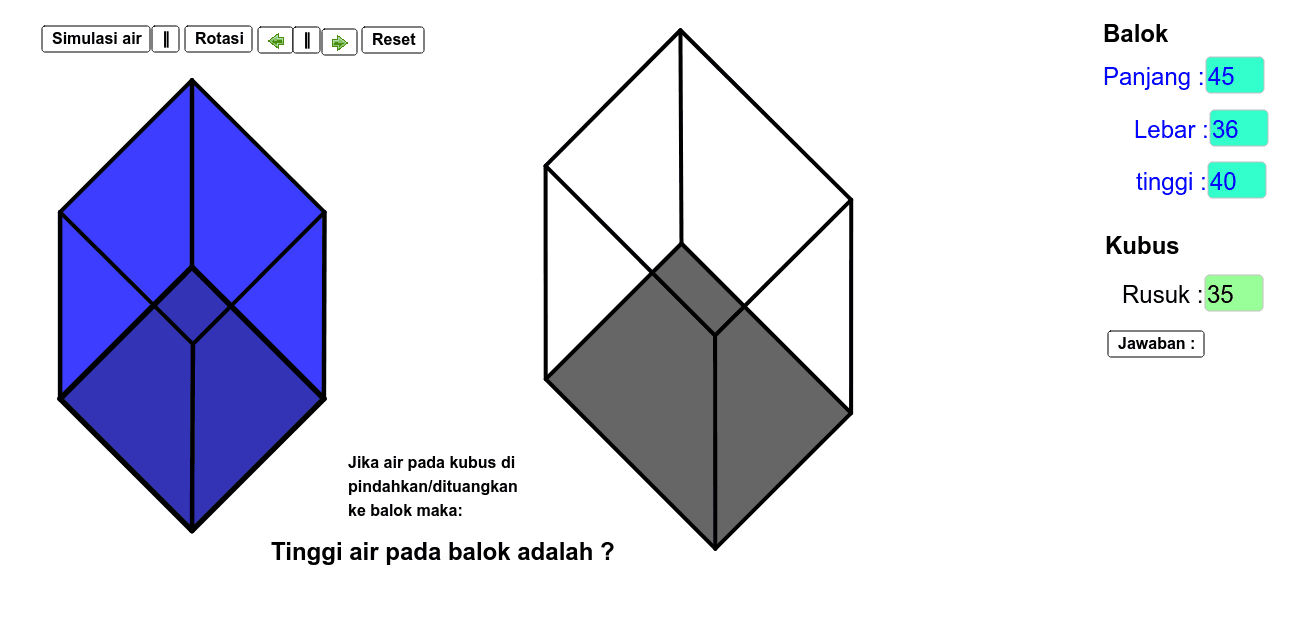
This example demonstrates the comparison and relationship between the volume calculations of a cube and a cuboid. It involves core mathematical concepts such as volume formulas, arithmetic mean, continuity, triangles, multiplication, and probability. The construction uses GeoGebra commands and objects like Point, Segment, Polygon, Intersect, Rotate, Vector, Translate, and Textfield. It is suitable for high school students learning and understanding solid geometry volume calculations and related mathematical concepts.
GeoGebra Commands & Parameters
Point(Circle[A, r]) → BSegment(A, B) → fPoint(Circle[B, r]) → CSegment(B, C) → gPoint(Circle[C, r]) → DSegment(C, D) → hPolygon(D, A, B, C) → poly1, d, a, b, cSegment(D, B) → iSegment(A, C) → jIntersect(j, i) → ERotate(D, (-rot), E) → D'Rotate(A, (-rot), E) → A'Rotate(B, (-rot), E) → B'Rotate(C, (-rot), E) → C'Polygon(D', A', B', C') → poly1', d', a', b', c'Point(Circle[F, r]) → GSegment(F, G) → kPoint(Circle[G, r]) → HSegment(G, H) → mPoint(Circle[H, r]) → ISegment(H, I) → nSegment(I, G) → qSegment(F, H) → sIntersect(s, q) → JPoint(Circle[A', r]) → KSegment(A', K) → tPoint(Circle[D', r]) → LSegment(D', L) → ePoint(Circle[C', r]) → MSegment(C', M) → f_1Point(Circle[B', r]) → NSegment(B', N) → g_1Polygon(K, N, M, L) → poly2, k_1, n_1, m_1, l_1Point(Circle[O, airk]) → PSegment(O, P) → h_1Vector(P, O) → uTranslate(N, u) → N'Translate(M, u) → M'Translate(L, u) → L'Translate(K, u) → K'Translate(O, Vector[(0, 0)]) → O'Translate(P, Vector[(0, 0)]) → P'Segment(O', P') → i_1Polygon(N', B', C', M') → poly3, n', b'_1, c'_1, m'Polygon(M', L', D', C') → poly4, m'_1, l', d'_1, c'_2Polygon(K', L', D', A') → poly5, k', l'_1, d'_2, a'_1Polygon(K', N', B', A') → poly6, k'_1, n'_1, b'_2, a'_2Polygon(N', K', L', M') → poly7, n'_2, k'_2, l'_2, m'_2Point(Circle[Q, p]) → RSegment(Q, R) → j_1Point(Circle[R, l]) → SSegment(R, S) → p_1Point(Circle[S, p]) → USegment(S, U) → r_1Polygon(U, Q, R, S) → poly8, u_1, q_1, r_2, s_1Segment(U, R) → t_1Segment(S, Q) → a_1Intersect(a_1, t_1) → TRotate(U, (-rot), T) → U'Rotate(Q, (-rot), T) → Q'Rotate(R, (-rot), T) → R'Rotate(S, (-rot), T) → S'Polygon(U', Q', R', S') → poly8', u', q', r', s'Point(Circle[Q', ti]) → VSegment(Q', V) → b_1Point(Circle[S', ti]) → WSegment(S', W) → c_1Point(Circle[U', ti]) → ZSegment(U', Z) → d_1Point(Circle[R', ti]) → A_1Segment(R', A_1) → e_1Polygon(Z, V, A_1, W) → poly9, z_1, v, a_2, wPoint(Circle[B_1, tbair]) → C_1Segment(B_1, C_1) → f_2Vector(B_1, C_1) → v_1Translate(S', v_1) → S''Translate(U', v_1) → U''Translate(Q', v_1) → Q''Translate(R', v_1) → R''Polygon(R', R'', S'', S') → poly10, r'_1, r'', s'', s'_1Polygon(S'', U'', U', S') → poly11, s''_1, u'', u'_1, s'_2Polygon(R'', Q'', Q', R') → poly12, r''_1, q'', q'_1, r'_2Polygon(Q'', U'', U', Q') → poly13, q''_1, u''_1, u'_2, q'_2Polygon(Q'', R'', S'', U'') → poly14, q''_2, r''_2, s''_2, u''_2Textfield(p) → InputBox1Textfield(l) → InputBox2Textfield(ti) → InputBox3Textfield(r) → InputBox4