
Crossed Beret
Loading the math board and drawing, please wait…
In collections
geometriadinamica.es
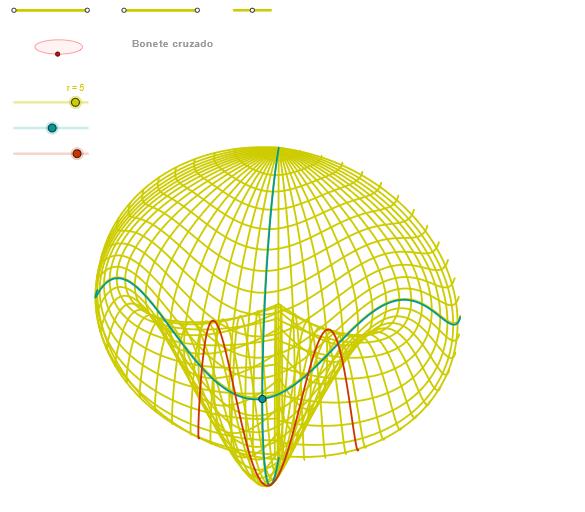
This example demonstrates the geometric construction of a crossed beret. It involves quadratic functions, geometric constructions, and indefinite integrals. Using GeoGebra commands such as Segment, Point, Intersect, etc., the shape of the beret can be constructed. Suitable for high school mathematics education and learning.
GeoGebra Commands & Parameters
Segment(Q5, Q6) → p5Point(p5) → P5Segment(Q3, Q4) → p2Point(p2) → P3Segment(P3, Q4) → p4Point(p4) → P4Segment(Q1, Q2) → p1Point(p1) → P1Segment(P1, Q2) → p3Point(p3) → P2OrthogonalLine(C, xAxis) → zz2Circle(C, 0.62) → zz0Intersect(zz0, zz2, 1) → ZZ4Intersect(zz0, zz2, 2) → ZZ3Ellipse(ZZ3, ZZ4, 0.65) → zElipse2Point(zElipse2) → ZIntersect(zElipse2, zz2) → ZZ7, ZZ8Angle(ZZ8, C, Z) → zAngIncOrthogonalLine(C, yAxis) → zz1Intersect(zz0, zz1, 2) → ZZ2Intersect(zz0, zz1, 1) → ZZ1Ellipse(ZZ1, ZZ2, 0.65) → zElipse1Point(zElipse1) → XYIntersect(zElipse1, zz1) → ZZ5, ZZ6Angle(ZZ6, C, XY) → zAngRotSegment(ZZ5, ZZ6) → zz4Segment(ZZ7, ZZ8) → zz3Intersect(zElipse2, zElipse1, 1) → zPunto1Intersect(zElipse2, zElipse1, 4) → zPunto2Segment(zPunto1, zPunto2) → zSeg2CurveCartesian((r * (((cos(α / 2) * sin((2 * v))) * sin(zAngRot)) + ((sin(α / 2) * sin((2 * v))) * cos(zAngRot)))), (r * (((((-cos(α / 2)) * sin((2 * v))) * cos(zAngRot)) * sin(zAngInc)) + (((sin(α / 2) * sin((2 * v))) * sin(zAngRot)) * sin(zAngInc)) - (((cos(v))^(2) - ((cos(α))^(2) * (sin(v))^(2))) * cos(zAngInc)))), v, v1, v2) → curva2CurveCartesian((r * (((cos(u / 2) * sin((2 * 3.14159 / 4))) * sin(zAngRot)) + ((sin(u / 2) * sin((2 * 3.14159 / 4))) * cos(zAngRot)))), (r * (((((-cos(u / 2)) * sin((2 * 3.14159 / 4))) * cos(zAngRot)) * sin(zAngInc)) + (((sin(u / 2) * sin((2 * 3.14159 / 4))) * sin(zAngRot)) * sin(zAngInc)) - (((cos(3.14159 / 4))^(2) - ((cos(u))^(2) * (sin(3.14159 / 4))^(2))) * cos(zAngInc)))), u, u1, u2) → curva1CurveCartesian((r * (((cos(u / 2) * sin((2 * β))) * sin(zAngRot)) + ((sin(u / 2) * sin((2 * β))) * cos(zAngRot)))), (r * (((((-cos(u / 2)) * sin((2 * β))) * cos(zAngRot)) * sin(zAngInc)) + (((sin(u / 2) * sin((2 * β))) * sin(zAngRot)) * sin(zAngInc)) - (((cos(β))^(2) - ((cos(u))^(2) * (sin(β))^(2))) * cos(zAngInc)))), u, u1, u2) → a1Sequence(CurveCartesian[(r * (((cos(u / 2) * sin((2 * v))) * sin(zAngRot)) + ((sin(u / 2) * sin((2 * v))) * cos(zAngRot)))), (r * (((((-cos(u / 2)) * sin((2 * v))) * cos(zAngRot)) * sin(zAngInc)) + (((sin(u / 2) * sin((2 * v))) * sin(zAngRot)) * sin(zAngInc)) - (((cos(v))^(2) - ((cos(u))^(2) * (sin(v))^(2))) * cos(zAngInc)))), u, u1, u2], v, v1, v2, paso) → list2Sequence(CurveCartesian[(r * (((cos(u / 2) * sin((2 * v))) * sin(zAngRot)) + ((sin(u / 2) * sin((2 * v))) * cos(zAngRot)))), (r * (((((-cos(u / 2)) * sin((2 * v))) * cos(zAngRot)) * sin(zAngInc)) + (((sin(u / 2) * sin((2 * v))) * sin(zAngRot)) * sin(zAngInc)) - (((cos(v))^(2) - ((cos(u))^(2) * (sin(v))^(2))) * cos(zAngInc)))), v, v1, v2], u, u1, u2, (3 * paso)) → list1
AI Drawing Prompt Reference
Draw a crossed beret consisting of two intersecting ellipses. Start by creating two line segments as bases, then find their midpoints and draw perpendicular lines that intersect a circle to get four points. Use these points to form two ellipses. Next, identify the intersection points on the ellipses and connect them to outline the beret's edges. Finally, use curves to connect the points on the ellipses for a smoother appearance.
The prompt above was compiled from the original drawing commands and is for reference only.