
Cross Sections of a Rectangular Prism by Lepressley
Loading the math board and drawing, please wait…
In collections
Surface Area and Volume
Surface Area and Volume
Surface Area and Volume
Geometry Constructions
Math Models
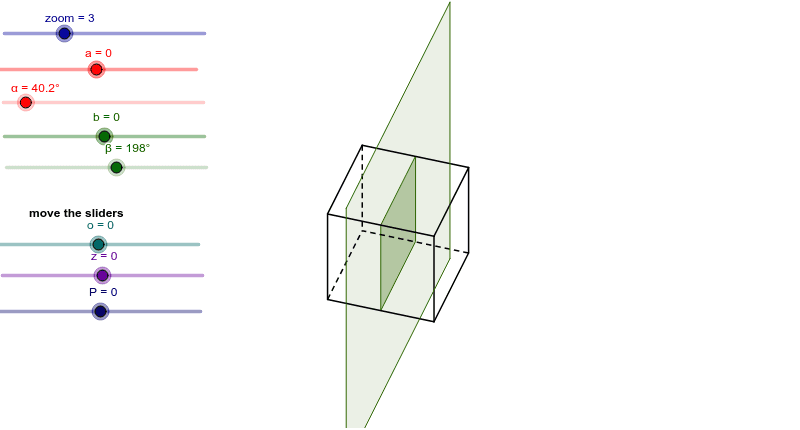
This example explores the different cross sections of a rectangular prism, helping students understand the concept of cross sections in solid geometry. Key mathematical concepts include solid geometry and polygons. Using GeoGebra commands such as Odcinek_3D, Element, and Polygon, students can visually see the shapes of different cross sections. Suitable for middle school and above students learning solid geometry.
GeoGebra Commands & Parameters
Odcinek_3D(D1, D5, D4, D2) → c, dOdcinek_3D(D1, D2, D5, D4) → e, fOdcinek_3D(D1, D4, D2, D5) → g, hOdcinek_3D(D2, D6, D1, D3) → i, jOdcinek_3D(D2, D3, D6, D1) → k, lOdcinek_3D(D3, D7, D2, D4) → m, nOdcinek_3D(D3, D4, D7, D2) → p, qOdcinek_3D(D4, D8, D3, D1) → s, tOdcinek_3D(D8, D5, D7, D4) → a_1, b_1Odcinek_3D(D8, D7, D4, D5) → c_1, d_1Odcinek_3D(D7, D6, D3, D8) → e_1, f_1Odcinek_3D(D6, D5, D2, D7) → g_1, h_1Element(Join[B10], 1) → C10Element(Join[B10], 2) → D10Element(Join[B10], 3) → E10Element(Join[B11], 1) → C11Element(Join[B11], 2) → D11Element(Join[B11], 3) → E11Element(Join[B12], 1) → C12Element(Join[B12], 2) → D12Element(Join[B12], 3) → E12Element(Join[B13], 1) → C13Element(Join[B13], 2) → D13Element(Join[B13], 3) → E13Element(Join[B14], 1) → C14Element(Join[B14], 2) → D14Element(Join[B14], 3) → E14Polygon(F12, F13, F10, F11) → poly1, f12, f13, f10, f11IloczynSkalarny3D(B14, B15) → C15IloczynSkalarny3D(B15, C17) → E17IloczynSkalarny3D(B15, C18) → E18IloczynSkalarny3D(B15, C19) → E19IloczynSkalarny3D(B15, C20) → E20IloczynSkalarny3D(B15, C21) → E21IloczynSkalarny3D(B15, C22) → E22IloczynSkalarny3D(B15, C23) → E23IloczynSkalarny3D(B15, C24) → E24IloczynSkalarny3D(B15, C25) → E25IloczynSkalarny3D(B15, C26) → E26IloczynSkalarny3D(B15, C27) → E27IloczynSkalarny3D(B15, C28) → E28If((F17 ≥ 0) ∧ (F17 ≤ 1), F17) → G17If((F18 ≥ 0) ∧ (F18 ≤ 1), F18) → G18If((F19 ≥ 0) ∧ (F19 ≤ 1), F19) → G19If((F20 ≥ 0) ∧ (F20 ≤ 1), F20) → G20If((F21 ≥ 0) ∧ (F21 ≤ 1), F21) → G21If((F22 ≥ 0) ∧ (F22 ≤ 1), F22) → G22If((F23 ≥ 0) ∧ (F23 ≤ 1), F23) → G23If((F24 ≥ 0) ∧ (F24 ≤ 1), F24) → G24If((F25 ≥ 0) ∧ (F25 ≤ 1), F25) → G25If((F26 ≥ 0) ∧ (F26 ≤ 1), F26) → G26If((F27 ≥ 0) ∧ (F27 ≤ 1), F27) → G27If((F28 ≥ 0) ∧ (F28 ≤ 1), F28) → G28RemoveUndefined(list1) → list2Sequence(Angle[Element[list2, 1], F14, Element[list2, i]], i, 1, Length[list2]) → list3Sort(list3) → list4Sequence(Sequence[If[Element[list3, j] ≟ Element[list4, i], Element[list2, j]], j, 1, Length[list2]], i, 1, Length[list4]) → list5RemoveUndefined(Join[list5]) → list6Polygon(list6) → wielokąt1, , , ,
AI Drawing Prompt Reference
Draw a rectangular prism and show the cross sections obtained by slicing it with different planes, including various polygons. First, draw the edges of the prism, then slice the prism with different planes to display the cross sections, such as triangles and quadrilaterals, and label the key points and cross-sectional shapes.
The prompt above was compiled from the original drawing commands and is for reference only.