
Cross Sections of a Hexagonal Prism
Loading the math board and drawing, please wait…
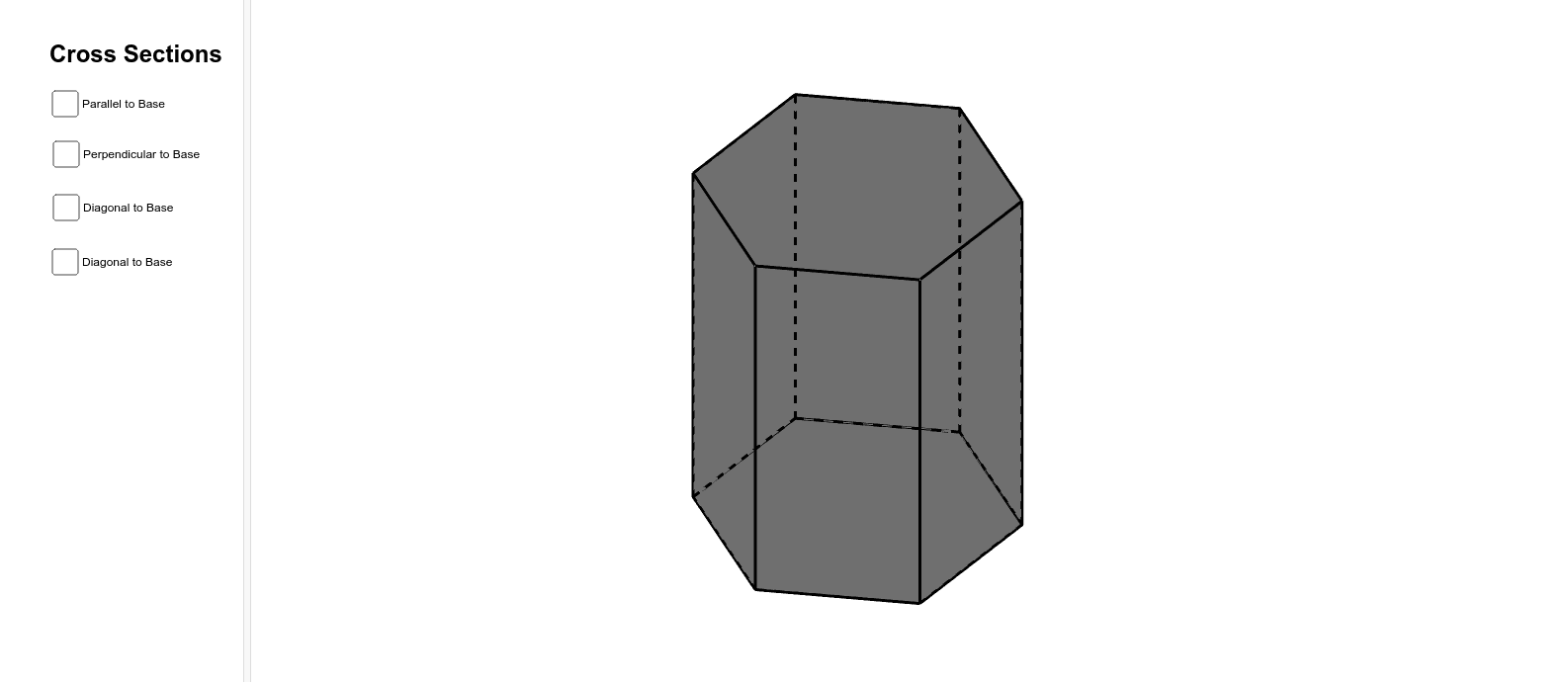
This GeoGebra example demonstrates the cross-sections formed by intersecting a hexagonal prism with various planes. Key mathematical concepts include solid geometry, polygon classification, and spatial coordinate geometry. Construction utilizes commands like Prism, Plane, Intersect, and OrthogonalLine to define the solid and cutting surfaces dynamically. It is designed for high school students and educators to visualize spatial relationships and understand how plane intersections create different polygonal shapes within a prism.
GeoGebra Commands & Parameters
Intersect(xAxis, yAxis) → APoint(xAxis) → BPolygon(A, B, 6) → poly1, a, F, b, c, d, e, f, C, D, EPrism(poly1, 4.881975827544018) → g, G, faceDEKJ, faceEFLK, faceAFLG, faceGHIJKL, edgeAG, edgeBH, edgeCI, edgeDJ, edgeEK, edgeFL, H, edgeGH, edgeHI, edgeIJ, edgeJK, edgeKL, edgeGL, I, J, K, L, faceABHG, faceBCIH, faceCDJIPoint(edgeDJ) → MOrthogonalLine(M, edgeCI, space) → hOrthogonalLine(M, edgeEK, space) → iIntersect(edgeCI, h) → NIntersect(i, edgeEK) → OPlane(N, M, O) → jIntersectPath(j, g) → poly2, P, n, p, q, Q, R, S, T, U, k, l, mPoint(edgeHI) → VPoint(edgeKL) → WOrthogonalLine(V, b, space) → rIntersect(b, r) → ZPlane(W, V, Z) → sIntersectPath(s, g) → poly3, A_1, B_1, C_1, D_1, t, a_1, b_1, c_1Point(edgeKL) → E_1Point(edgeGH) → F_1Point(edgeCI) → G_1Plane(F_1, E_1, G_1) → vIntersectPath(v, g) → poly4, H_1, f_1, g_1, h_1, i_1, j_1, I_1, J_1, K_1, L_1, M_1, N_1, d_1, e_1Point(edgeHI) → O_1Point(edgeIJ) → P_1Point(edgeCI) → Q_1Plane(O_1, P_1, Q_1) → k_1IntersectPath(k_1, g) → poly5, R_1, p_1, q_1, r_1, S_1, T_1, U_1, V_1, W_1, l_1, m_1, n_1
AI Drawing Prompt Reference
Draw a regular hexagonal prism with a base of a regular hexagon and a height of approximately 4.88. Inside the prism, construct several distinct planes, each intersecting the prism to form different cross-sectional polygons. The first plane passes through a point on one lateral edge and is perpendicular to two adjacent lateral edges, producing a hexagonal cross-section. The second plane passes through points on two opposite lateral edges and is perpendicular to one base edge, yielding a quadrilateral cross-section. The third plane passes through points on three lateral edges, forming a hexagonal cross-section. The fourth plane passes through points on three lateral edges, creating a pentagonal cross-section. Highlight all cross-sections with distinct colors or styles, and render the prism semi-transparent to reveal the internal structure.
The prompt above was compiled from the original drawing commands and is for reference only.