
Coxeter Theorem 2.21: Construction of Cross Ratio and Harmonic Conjugates
Loading the math board and drawing, please wait…
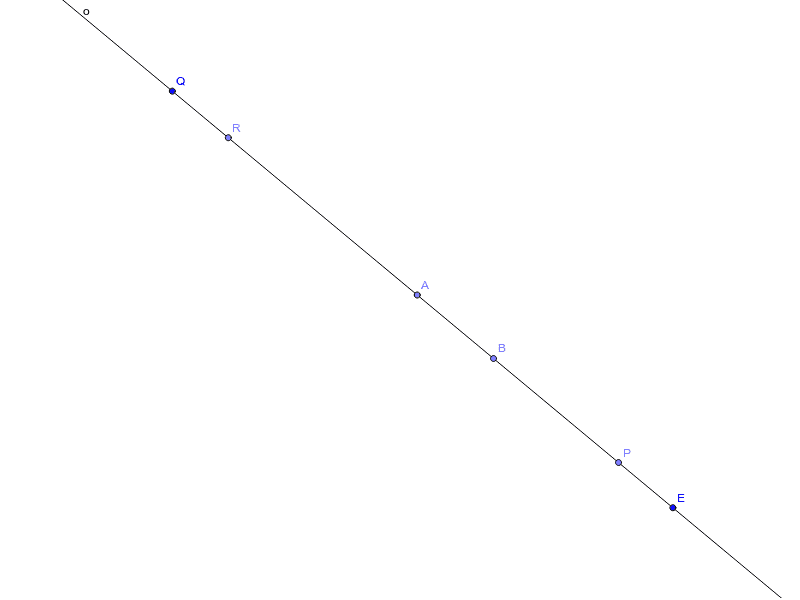
①This example demonstrates Theorem 2.21 from Coxeter's 'Projective Geometry' (Second Edition, page 17), illustrating fundamental properties of cross ratio and harmonic conjugates through a construction involving lines and points. ②Core mathematical concepts include projective geometry, cross ratio, harmonic point sets, perspectivity between point rows, and implications of Desargues' theorem. ③Construction details: Based on the summary, the GeoGebra commands used are Line and Point, creating objects Q, E, o, A, B, R, P. Points A and B lie on line o, while auxiliary points Q, E, R help construct point P, reflecting a typical projective construction using complete quadrilaterals or harmonic pencils. ④This is suitable for undergraduate projective geometry courses, mathematics enthusiasts, or as a classroom demonstration to visualize abstract theorems in a concrete geometric setting.
GeoGebra Commands & Parameters
Line(Q, E) → oPoint(o) → APoint(o) → BPoint(o) → RPoint(o) → P
AI Drawing Prompt Reference
Draw a horizontal base line and place five distinct points on it, with two serving as fixed reference points and the other three positioned along the line. From a point outside the line, draw five rays connecting to these points. Use these rays and auxiliary lines to construct intersections, then connect these intersections to find a new point on the base line that forms a harmonic conjugate with the two fixed reference points. The diagram illustrates the cross-ratio property in projective geometry, with clear lines and accurate point-line relationships, and key points may be labeled for clarity.
The prompt above was compiled from the original drawing commands and is for reference only.