
Corresponding Parts and Scale Factors Practice
Loading the math board and drawing, please wait…
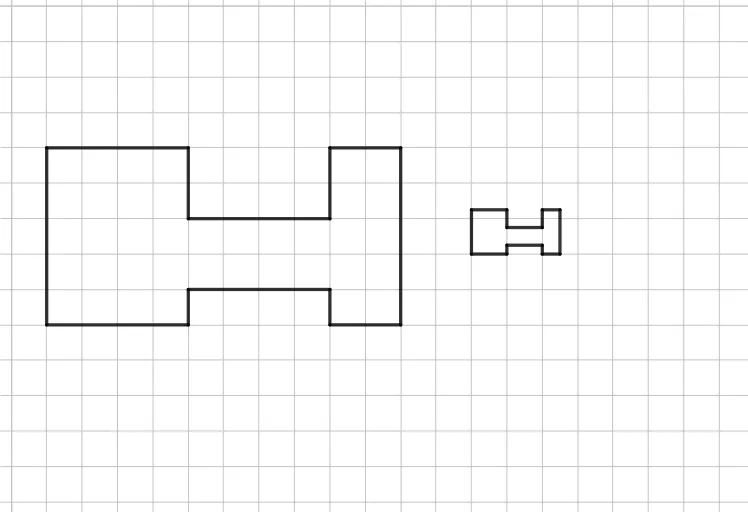
This GeoGebra example demonstrates how to identify corresponding parts and compute scale factors between similar figures. It visually shows the relationship between two shapes by constructing multiple segments and points, allowing students to compare side lengths and determine the scale factor. The core mathematical concepts involve similarity, proportional sides, and the definition of scale factor. The construction uses the Segment command to create numerous segments (labeled A, B, f, C, g, etc.) and points (M, N, O, P, etc.) to mark corresponding vertices, forming two similar figures. This practice is suitable for middle school mathematics (e.g., Grade 7) as a classroom exercise or homework, reinforcing the understanding of corresponding parts and proportional reasoning in similar figures.
GeoGebra Commands & Parameters
Segment(A, B) → fSegment(B, C) → gSegment(C, D) → hSegment(D, E) → iSegment(E, F) → jSegment(F, G) → kSegment(H, A) → lSegment(G, I) → mSegment(I, J) → nSegment(J, K) → pSegment(K, L) → qSegment(L, H) → rSegment(M, N) → sSegment(N, O) → tSegment(O, P) → aSegment(P, Q) → bSegment(Q, R) → cSegment(R, S) → dSegment(S, T) → eSegment(T, U) → f_1Segment(U, V) → g_1Segment(V, W) → h_1Segment(W, Z) → i_1Segment(Z, M) → j_1
AI Drawing Prompt Reference
Draw two similar polygons, one with vertices A, B, C, D, E, F, G, H, and the other with M, N, O, P, Q, R, S, T, U, V, W, Z. First, draw segments AB, BC, CD, DE, EF, FG, GH, and then MN, NO, OP, PQ, QR, RS, ST, TU, UV, VW, WZ. Next, draw lines connecting corresponding vertices, such as AM, BN, CO, DP, EQ, FR, GS, HT, and UZ, VM.
The prompt above was compiled from the original drawing commands and is for reference only.