
Coordinates of the Point Where the Terminal Side of an Angle with a Measure of 5
Loading the math board and drawing, please wait…
In collections
CCGPS AA Unit 5 Lesson 1
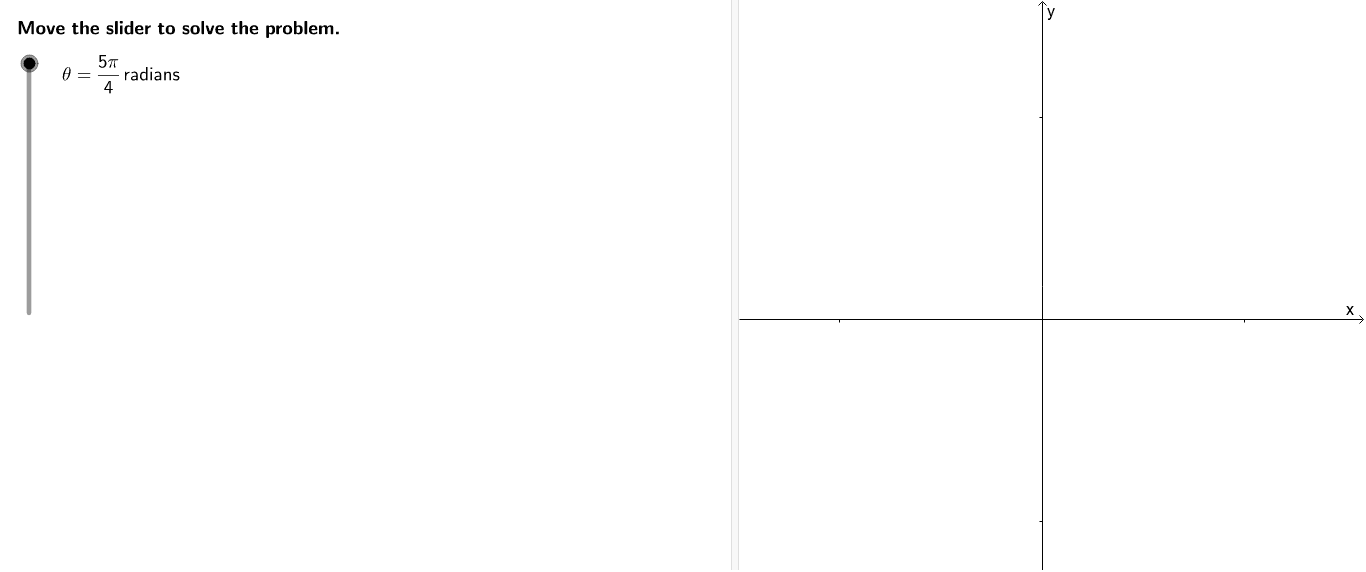
This example demonstrates the coordinates of the point where the terminal side of an angle with a measure of 5π/4 radians intersects the unit circle. Key mathematical concepts include the unit circle, sine, and cosine functions. Using GeoGebra commands such as Circle, Segment, and Angle, the relationship between the angle and coordinates is dynamically illustrated. Suitable for high school mathematics education and learning.
GeoGebra Commands & Parameters
LaTeX(steps) → counterCircle((0, 0), 1) → cLaTeX("\text{0 radians}") → zeroLaTeX("\text{Sketch the angle.}") → text3If(angleNum / angleDen < 1, Sequence[i / angleDen, i, 1, angleDen - 1], Sequence[1 + i / angleDen, i, 1, angleDen - 1]) → list1Zip((cos((a * π)), sin((a * π))), a, list1) → list2Zip(Segment[(0, 0), a], a, list2) → list3Segment((0, 0), C) → aSegment((0, 0), (1, 0)) → bAngle(A, (0, 0), C) → θIf(0 < factor ≤ 0.5, LaTeX["\text{I}"], If[0.5 < factor ≤ 1, LaTeX["\text{II}"], If[1 < factor ≤ 1.5, LaTeX["\text{III}"], LaTeX["\text{IV}"]]]) → quadrantIf(0 < factor ≤ 0.5, LaTeX["\text{The measure of the original angle is the measure of the reference angle.}"], If[0.5 < factor ≤ 1, LaTeX["\text{Subtract the measure of the original angle from π radians to find the }\cr\text{measure of the reference angle.}"], If[1 < factor ≤ 1.5, LaTeX["\text{Subtract π radians from the original angle measure to find the}\cr\text{measure of the reference angle.}"], LaTeX["\text{Subtract the measure of the original angle from 2π radians to find the }\cr\text{measure of the reference angle.}"]]]) → subtractionIf(0 < factor ≤ 0.5, angleNum, If[0.5 < factor ≤ 1, angleDen - angleNum, If[1 < factor ≤ 1.5, angleNum - angleDen, (2 * angleDen) - angleNum]]) → refNumIf(0 < factor ≤ 0.5, Angle[A, (0, 0), C], If[0.5 < factor ≤ 1, Angle[C, (0, 0), B], If[1 < factor ≤ 1.5, Angle[B, (0, 0), C], Angle[C, (0, 0), A]]]) → θ_{ref}LaTeX((((("\theta=\frac{" * angleNum) * "\pi}{") * angleDen) * "} radians")) → ProblemLaTeX((((((("\textcolor{#CC0000}{\sin(\theta_{ref})=\sin\left(\frac{" * refNum) * "}{") * angleDen) * "}\pi\right)\approx") * sinRef) * "}")) → text11LaTeX((((((("\textcolor{#CC0000}{\cos(\theta_{ref})=\cos\left(\frac{" * refNum) * "}{") * angleDen) * "}\pi\right)\approx") * cosRef) * "}")) → text12LaTeX("\text{Determine the coordinates of point }\textcolor{#006633}{C}.") → text14If(0 < factor ≤ 0.5, LaTeX["\text{(+,+)}"], If[0.5 < factor ≤ 1, LaTeX["\text{(-,+)}"], If[1 < factor ≤ 1.5, LaTeX["\text{(-,-)}"], LaTeX["\text{(+,-)}"]]]) → signsIf(0 < factor ≤ 0.5, LaTeX["\textcolor{#006633}{(\cos(\theta),\sin(\theta))}=\textcolor{#CC0000}{(\cos(\theta_{ref}),\sin(\theta_{ref}))}"], If[0.5 < factor ≤ 1, LaTeX["\textcolor{#006633}{(\cos(\theta),\sin(\theta))}=\textcolor{#CC0000}{(-\cos(\theta_{ref}),\sin(\theta_{ref}))}"], If[1 < factor ≤ 1.5, LaTeX["\textcolor{#006633}{(\cos(\theta),\sin(\theta))}=\textcolor{#CC0000}{(-\cos(\theta_{ref}),-\sin(\theta_{ref}))}"], LaTeX["\textcolor{#006633}{(\cos(\theta),\sin(\theta))}=\textcolor{#CC0000}{(\cos(\theta_{ref}),-\sin(\theta_{ref}))}"]]]) → text16LaTeX("\text{Move the slider to solve the problem.}") → text0LaTeX("\text{Sketch a unit circle, and then label π radians and 2π radians.}") → text1LaTeX("\text{A half rotation (180°) is π radians and a full rotation (360°) is 2π radians. }\cr\text{Notice that 0 radians and 2π radians are in the same location on the unit circle, }\cr\text{but represent different angle measures.}") → text2If(angleNum / angleDen < 1, LaTeX[(((((((((((((((((("\frac{" * angleNum) * " π}{") * angleDen) * "}\text{is the same as }\frac{") * angleNum) * "}{") * angleDen) * "} π. \cr\text{In other words, the terminal side is }\frac{") * angleNum) * "}{") * angleDen) * "}\text{ of the way from 0 to π.}\cr\text{Thus, imagine the semicircle between 0 radians and π radians split into ") * angleDen) * " parts }\cr\text{and then sketch the angle }\frac{") * angleNum) * "}{") * angleDen) * "}\text{ of the way around the semicircle.}")], LaTeX[(((((((((((((((((("\frac{" * angleNum) * " π}{") * angleDen) * "}\text{is the same as }\left(1+\frac{") * newNum) * "}{") * angleDen) * "}\right) π. \cr\text{In other words, the terminal side is }\frac{") * newNum) * "}{") * angleDen) * "} \text{ of the way from π to 2π. }\cr\text{Thus, imagine the semicircle between π radians and 2π radians split into ") * angleDen) * " parts }\cr\text{and then sketch the angle }\frac{") * newNum) * "}{") * angleDen) * "}\text{ of the way around the semicircle.}")]) → text4LaTeX("\text{The coordinates of point }\textcolor{#006633}{C}\text{ are given by } \textcolor{#006633}{(\cos(\theta),\sin(\theta))}\text{ which can be evaluated }\cr\text{from the reference angle }\textcolor{#CC0000}{\theta_{ref}}.") → text5LaTeX("\text{Determine }\textcolor{#CC0000}{\sin(\theta_{ref})}\text{ and }\textcolor{#CC0000}{\cos(\theta_{ref})}\text{ in order to determine }\textcolor{#006633}{\sin(\theta)}\text{ and }\textcolor{#006633}{\cos(\theta)}.") → text10LaTeX("\text{Because the reference angle is always between 0 and }\frac{\pi}{2} \text{radians, the sine}\cr\text{and cosine of the reference angle are always non-negative.}") → text13LaTeX((((("\text{Since point }\textcolor{#006633}{C}\text{ and the terminal side lie in quadrant }" * quadrant) * ", \cr\text{the signs of the coordinates of point }\textcolor{#006633}{C}\text{ are } ") * signs) * ".")) → text15LaTeX("\text{Use the buttons below to return to the original problem or}\cr\text{randomly generate a similar practice problem.}") → text18LaTeX("\text{Determine the measure of the reference angle, which is the measure of the}\cr\text{angle between the terminal side and the x-axis. }") → text6LaTeX((((("\text{The terminal side falls in Quadrant } " * quadrant) * ".\cr") * subtraction) * "")) → text7If(0 < factor ≤ 0.5, LaTeX[(((("\textcolor{#CC0000}{frac{" * refNum) * "}{") * angleDen) * "}π \text{ radian(s)}}")], If[0.5 < factor ≤ 1, LaTeX[(((((((((((("\textcolor{#CC0000}{\frac{" * angleDen) * "}{") * angleDen) * "}π -\frac{") * angleNum) * "}{") * angleDen) * "}π =\frac{") * refNum) * "}{") * angleDen) * "}π \text{ radian(s)}}")], If[1 < factor ≤ 1.5, LaTeX[(((((((((((("\textcolor{#CC0000}{\frac{" * angleNum) * "}{") * angleDen) * "}π -\frac{") * angleDen) * "}{") * angleDen) * "}π =\frac{") * refNum) * "}{") * angleDen) * "}π \text{ radian(s)}}")], LaTeX[(((((((((((("\textcolor{#CC0000}{\frac{2(" * angleDen) * ")}{") * angleDen) * "}π -\frac{") * angleNum) * "}{") * angleDen) * "}π =\frac{") * refNum) * "}{") * angleDen) * "}π\text{ radian(s)}}")]]]) → text8LaTeX((((((((("\text{The reference angle for }\frac{" * angleNum) * "\text{ }\pi}{") * angleDen) * "}\text{ radians is }\frac{") * refNum) * "\text{ }\pi}{") * angleDen) * "}\text{ radian(s).}")) → text9LaTeX((("\text{The coordinates of point }\textcolor{#006633}{C}\text{ are approximately } \textcolor{#006633}{" * C) * "}.")) → text17
AI Drawing Prompt Reference
Draw a unit circle and mark 0 radians and 2π radians on it. Sketch the terminal side of an angle measuring 5π/4 radians, which lies in the fourth quadrant. Determine the reference angle and calculate its sine and cosine values. The coordinates of the point C where the terminal side intersects the unit circle are the solution.
The prompt above was compiled from the original drawing commands and is for reference only.