
Convert number to sum of different Fibonacci numbers
Loading the math board and drawing, please wait…
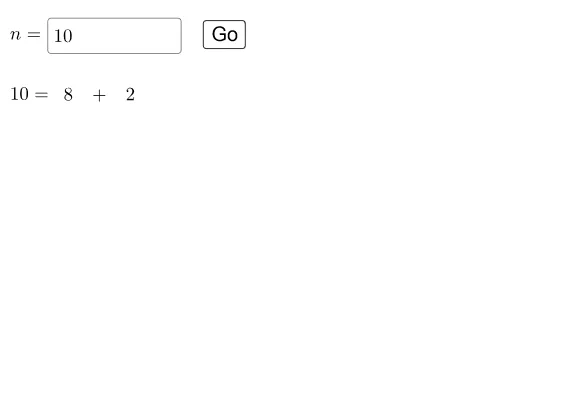
This example demonstrates how to express a number as a sum of different Fibonacci numbers. It involves core mathematical concepts like the Fibonacci sequence and number theory. Construction highlights the use of GeoGebra commands such as Length, Take, Sequence, Textfield, IterationList, If, TableText to achieve Fibonacci decomposition through iteration and conditional logic. Suitable for high school and above students to understand sequence applications and algorithm design.
GeoGebra Commands & Parameters
Length(result) → lenResultTake(Flatten[Zip[{(a * ""), "+"}, a, result]], 1, (2 * lenResult) - 1) → resultTextSequence(Sequence[Element[resultText, (nLAfter * j) + k], k, 1, nLAfter], j, 0, floor(Length[resultText] / nLAfter)) → l2Textfield(n) → InputBox1IterationList(a + b, a, b, {0, 1}, k) → l1If(Defined[resultText], TableText[resultText]) → text2TableText(l2, "lh") → text3
AI Drawing Prompt Reference
Create a graphic that decomposes a number into a sum of different Fibonacci numbers. First, input a number, then generate the Fibonacci sequence through iteration, and finally identify which Fibonacci numbers can be added to form the given number, displaying these terms in an addition format.
The prompt above was compiled from the original drawing commands and is for reference only.