
Construction of Trigonometric Function Graphs
Loading the math board and drawing, please wait…
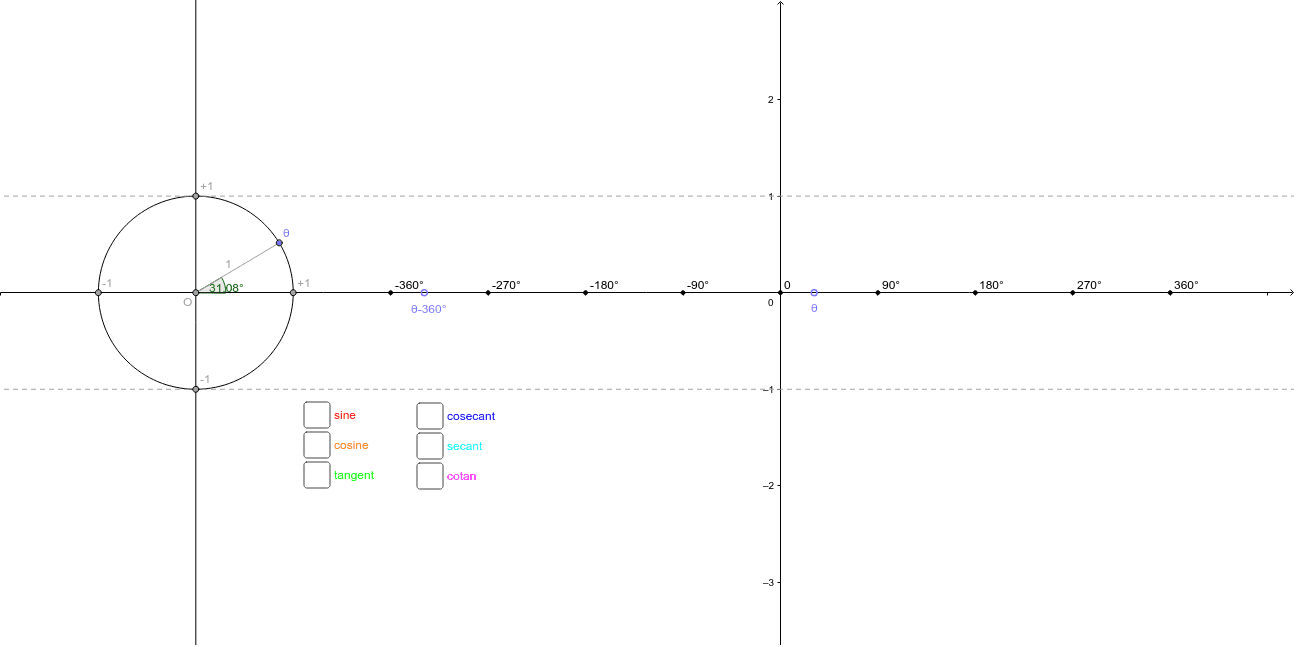
This example demonstrates the construction of the graphs of the six trigonometric functions. Key math concepts include trigonometric functions, unit circle, and trigonometric identities. GeoGebra commands used in the construction are Circle, Point, Angle, Segment, OrthogonalLine, Line, Intersect, and Mirror. Suitable for high school students to learn and understand the geometric meaning of trigonometric function graphs.
GeoGebra Commands & Parameters
Circle(A, B) → cPoint(c) → KAngle(B, A, K) → αSegment(A, K) → aSegment(B, C) → bOrthogonalLine(B, b) → dLine(A, K) → eIntersect(d, e) → LSegment(L, A) → fOrthogonalLine(K, xAxis) → gOrthogonalLine(A, xAxis) → hLine(K, xAxis) → iIntersect(h, i) → MIntersect(g, xAxis) → NCircle(A, N) → kLine(O, b) → jLine(B_1, C_1) → lLine(Z, A_1) → mLine(U, T) → nIntersect(c, h, 2) → D_1Intersect(c, h, 1) → E_1Intersect(c, xAxis, 1) → F_1Segment(K, N) → qSegment(B, L) → sSegment(K, N) → tSegment(A, N) → a_1Intersect(d, e) → G_1Circle(A, G_1) → c_1OrthogonalLine(D_1, h) → b_1Intersect(e, b_1) → H_1Circle(A, H_1) → d_1OrthogonalLine(E_1, h) → e_1Intersect(e, b_1) → I_1Segment(D_1, I_1) → h_1Mirror(D_1, g_1) → J_1Mirror(I_1, g_1) → K_1Segment(J_1, K_1) → i_1Segment(N_1, S) → f_1Segment(M_1, R) → k_1Segment(N_1, Q) → l_1Segment(M_1, P) → m_1Segment(N_1, U) → n_1Segment(M_1, T) → p_1Segment(A, G_1) → s_1Line(B, G_1) → pOrthogonalLine(K, xAxis) → q_1Intersect(q_1, xAxis) → VSegment(A, V) → r_1OrthogonalLine(W, h) → t_1Segment(N_1, P_1) → a_2Segment(O_1, M_1) → b_2Segment(V, K) → c_2OrthogonalLine(F_1, xAxis) → d_2Intersect(c_1, e, 2) → Q_1Segment(A, Q_1) → e_2Intersect(d_1, e, 2) → R_1Segment(A, H_1) → f_2Segment(A, R_1) → g_2OrthogonalLine(K, h) → h_2Intersect(h, h_2) → S_1Segment(K, S_1) → i_2Segment(A, I_1) → j_2
AI Drawing Prompt Reference
Draw a unit circle centered at the origin. Pick a point on the circle, connect it to the center to form a radius, and mark the angle between this radius and the horizontal diameter. From the point on the circle, drop a perpendicular to the horizontal diameter, and from the center, draw a perpendicular to the radius; these two perpendiculars intersect at a point, which is then connected to the center. Next, drop a perpendicular from the circle point to the horizontal axis, marking the foot, and draw a new circle centered at the origin with radius equal to the distance from the origin to that foot. Then construct a series of parallel and perpendicular lines to form a grid, using intersections and reflections to gradually outline the graphs of the six trigonometric functions, including sine, cosine, and tangent, with each curve defined by key intersection points and connecting segments.
The prompt above was compiled from the original drawing commands and is for reference only.