
Construction and Geometric Properties of a Square Prism
Loading the math board and drawing, please wait…
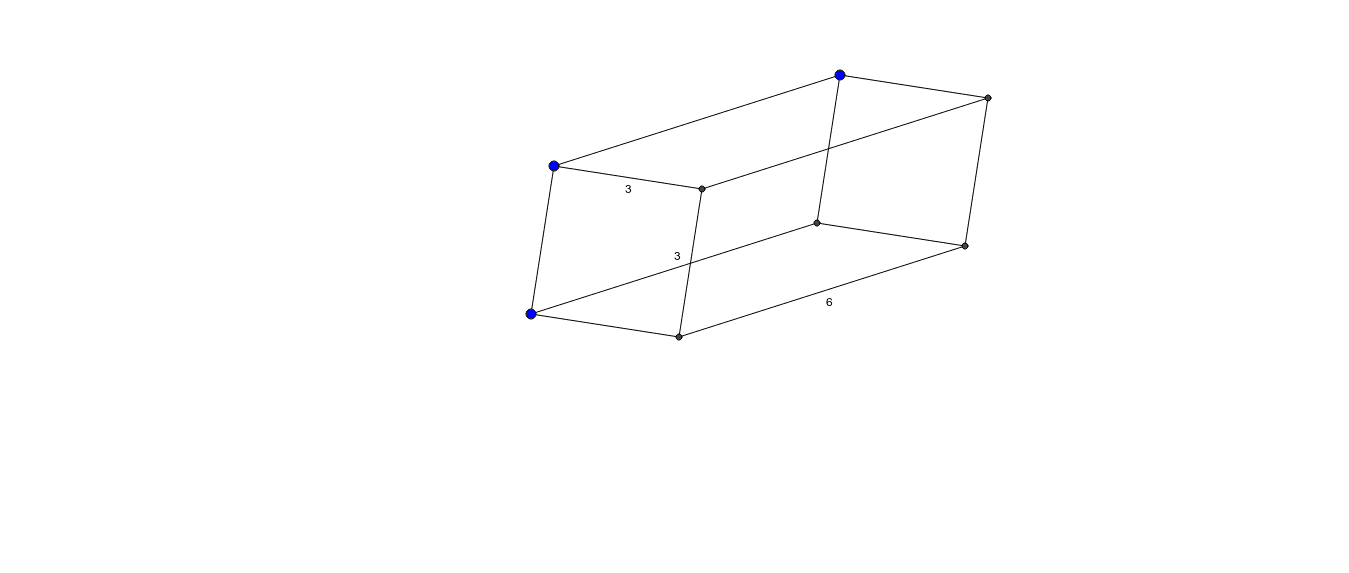
① This example demonstrates the construction of a square prism in 3D space, allowing learners to visually understand the shape and structure of a prism. ② Core mathematical concepts include the definition of a prism, square base, rectangular lateral faces, and perpendicular/parallel relationships in solid geometry; it also touches on conditional probability, orthocenter, division, and arithmetic operations as extended topics, but the main focus is solid geometry. ③ Construction details: Using GeoGebra commands such as Circle, Segment, OrthogonalLine, Intersect, and Line, multiple points (A, B, C, D, E, F, G, H) and segments (c, f, g, h, d, i, j, k, e, l, m, p, n, q, r, s, t, a, b, f_1, g_1, h_1, i_1, j_1) are constructed. Perpendicular lines and intersection points determine the vertices and edges, ultimately forming a complete square prism. ④ Suitable for high school or early college solid geometry teaching, as well as math lab activities to explore prism properties and enhance spatial reasoning.
GeoGebra Commands & Parameters
Circle(B, A) → cSegment(B, A) → fOrthogonalLine(B, f) → gIntersect(c, g, 2) → CSegment(B, C) → hCircle(C, B) → dOrthogonalLine(C, h) → iIntersect(d, i, 1) → DSegment(D, A) → jSegment(C, D) → kCircle(B, E) → eSegment(B, E) → lLine(E, h) → mCircle(E, B) → pLine(C, l) → nIntersect(m, n) → FSegment(E, F) → qSegment(F, C) → rLine(D, r) → sLine(F, k) → tIntersect(s, t) → GSegment(F, G) → aSegment(D, G) → bLine(E, a) → f_1Line(G, q) → g_1Intersect(f_1, g_1) → HSegment(E, H) → h_1Segment(H, G) → i_1Segment(H, A) → j_1
AI Drawing Prompt Reference
Draw a right square prism in 3D space. Start with a circle to define the base square's vertices, then connect them to form the base. From one base vertex, draw a vertical edge, and use it to construct the top square parallel to the base, ensuring corresponding vertices are connected by perpendicular edges. The result is a solid with two square bases and four rectangular lateral faces, illustrating parallel and perpendicular relationships.
The prompt above was compiled from the original drawing commands and is for reference only.