
Constructing Triangles from Three Common Measures
Loading the math board and drawing, please wait…
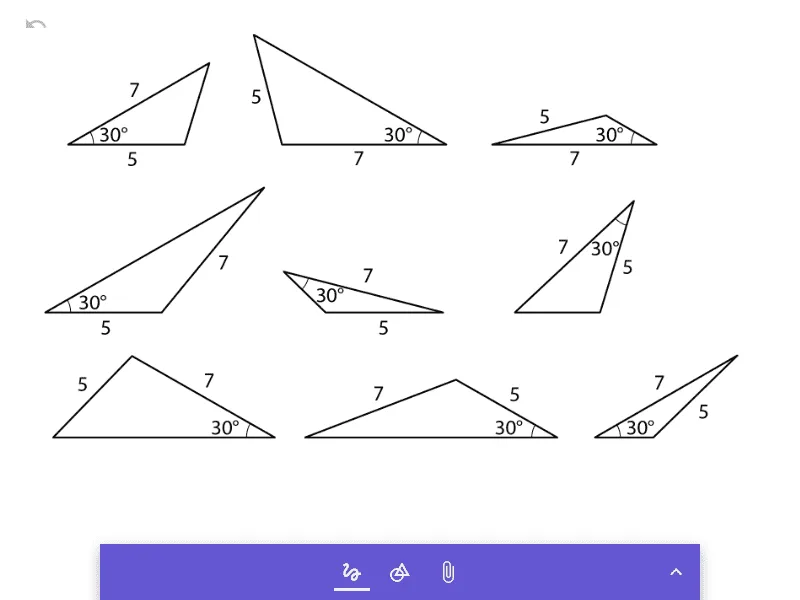
This example demonstrates how to construct triangles when three common measurement conditions are given, and how the resulting shapes can reveal feasibility differences and visible symmetry patterns across varying inputs. The key math ideas include metric constraints for triangles, the construction approach that supports uniqueness/consistency reasoning under given measures, and a data-oriented viewpoint connected to statistics—e.g., using integer (discrete) measure sets to generate and compare multiple candidate triangles. From the provided construction summary, the main GeoGebra object is pic1, which serves as the visualization canvas for the constructed triangle geometry. Based on the site themes (Symmetry, Integers, Statistics), the figure is intended to highlight symmetric configurations when applicable and to compare outcomes coming from discrete (integer) measurements, possibly with auxiliary metric/statistical cues. Suitable for middle/high school geometry lessons, investigative learning, and classroom demonstrations focused on “given measures → geometric construction → reasoning from the drawn relationships.”
AI Drawing Prompt Reference
Draw triangles based on three measurement conditions, showing feasibility differences and symmetry patterns. Generate multiple candidate triangles using integer measurement sets and compare their shapes and symmetry. Highlight symmetric configurations and demonstrate the reasoning from given measurements to geometric construction.
The prompt above was compiled from the original drawing commands and is for reference only.