
Constructing Parallelograms: Polygon Area and Geometric Construction
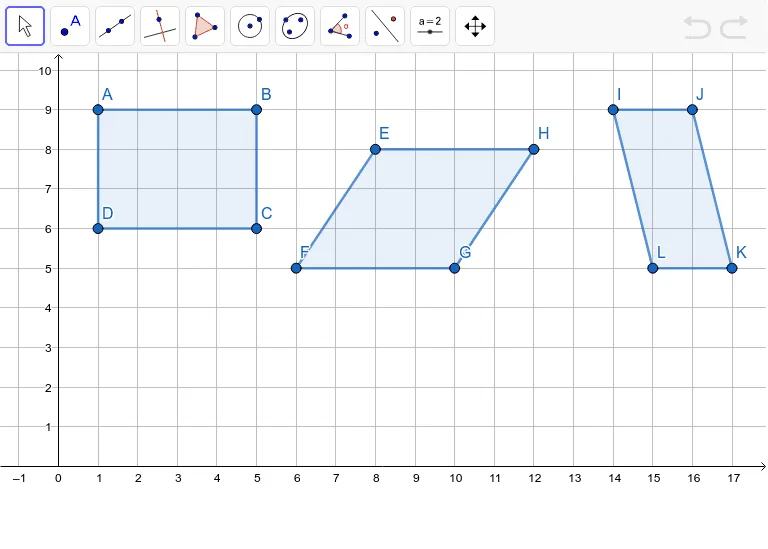
This GeoGebra applet demonstrates how to construct parallelograms through step-by-step geometric construction. The interactive activity guides students through building multiple polygons and examining their areas, allowing them to explore the fundamental geometric properties and area relationships that define parallelograms. By manipulating the constructed figures, learners can observe how the sides, angles, diagonals, and area of a parallelogram are interrelated, gaining a deeper understanding of why the area formula for a parallelogram equals base times height and how this relationship can be derived through dissection and rearrangement of shapes.
The applet is designed for classroom geometry instruction and provides an engaging, visual platform for students to experiment with geometric transformations. As users adjust vertices and drag points, they can immediately see how the properties of the parallelogram change or remain invariant, reinforcing key theorems about opposite sides being equal and parallel, opposite angles being congruent, and diagonals bisecting each other. This hands-on exploration helps bridge the gap between abstract geometric proofs and concrete visual understanding.
Students benefit from this interactive experience by developing stronger spatial reasoning skills and a more intuitive grasp of how parallelograms relate to other special quadrilaterals such as rectangles, rhombi, and squares. The applet highlights the hierarchical relationships within the family of quadrilaterals, showing how a rectangle is a special type of parallelogram with right angles, and how a rhombus is a special parallelogram with equal side lengths. By constructing and comparing these shapes, learners can appreciate the unifying geometric principles that connect different polygon types.
The activity also encourages mathematical curiosity and discovery-based learning. Rather than passively receiving formulas and definitions, students actively construct knowledge by testing hypotheses, making conjectures, and verifying their observations through the dynamic geometry environment. This approach fosters critical thinking and helps students build a more robust and lasting understanding of plane geometry concepts that serve as a foundation for more advanced mathematical study.
Loading the math board and drawing, please wait…