
Constructing Isogonal Conjugates
Loading the math board and drawing, please wait…
In collections
A Tour of Triangle Geometry
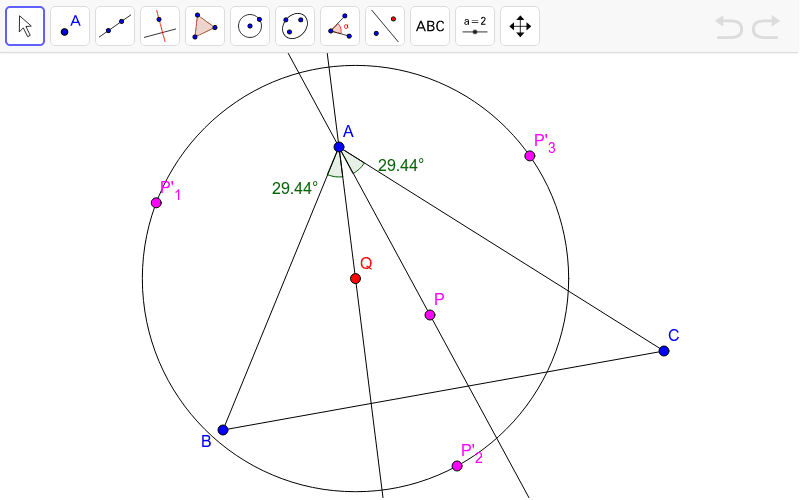
This example demonstrates how to reflect point P in the sides of a triangle to obtain three collinear points on a circle. The center of this circle, Q, is the isogonal conjugate of point P. Key mathematical concepts include triangles, circles, and isogonal conjugates. The construction uses Segment, Mirror, Circle, Center, Line, and Angle commands in GeoGebra. Suitable for high school geometry education.
GeoGebra Commands & Parameters
Segment(A, B) → aSegment(B, C) → bSegment(C, A) → cMirror(P, c) → P'_3Mirror(P, a) → P'_1Mirror(P, b) → P'_2Circle(P'_3, P'_1, P'_2) → dCenter(d) → QLine(A, Q) → eLine(A, P) → fAngle(B, A, Q) → αAngle(P, A, C) → β
AI Drawing Prompt Reference
Draw a triangle ABC, then reflect point P on each side of the triangle to get three new points P'1, P'2, and P'3. Use these three points to draw a circle with center Q. Draw a line e connecting point A and Q, and a line f connecting point A and P. The angle α formed by lines e and f is equal to the angle β formed by point P and point C. Point Q is the isogonal conjugate of point P.
The prompt above was compiled from the original drawing commands and is for reference only.