
Constructing a Parallelogram from Sides and Angle
Loading the math board and drawing, please wait…
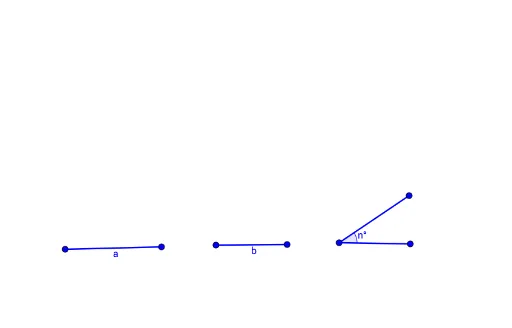
This example demonstrates how to construct a parallelogram given its side lengths and an included angle. Key math concepts involved include the definition of a parallelogram, geometric construction, and angle measurement. The construction process utilizes GeoGebra commands such as Segment, Angle, Ray, Rotate, Circle, Intersect, Line, and Polygon to systematically build the shape. It is suitable for middle school students and above learning geometric construction techniques, as well as for educational demonstrations.
GeoGebra Commands & Parameters
Segment(A, B) → aSegment(G, H) → bSegment(I, J) → nSegment(J, K) → pAngle(K, J, I) → αRay(C, D) → gRotate(D, α, C) → D'Angle(D, C, D') → βRay(C, D') → hCircle(C, a) → cIntersect(c, g, 1) → ELine(E, h) → iCircle(E, Segment[G, H]) → dIntersect(d, i, 2) → FLine(F, g) → jIntersect(j, h) → LPolygon(C, E, F, L) → target1, c_1, e, f_1, l