
Constant Cross‑Sectional Area of a Prism
Loading the math board and drawing, please wait…
In collections
S.2 Ch.13 Area of Circle
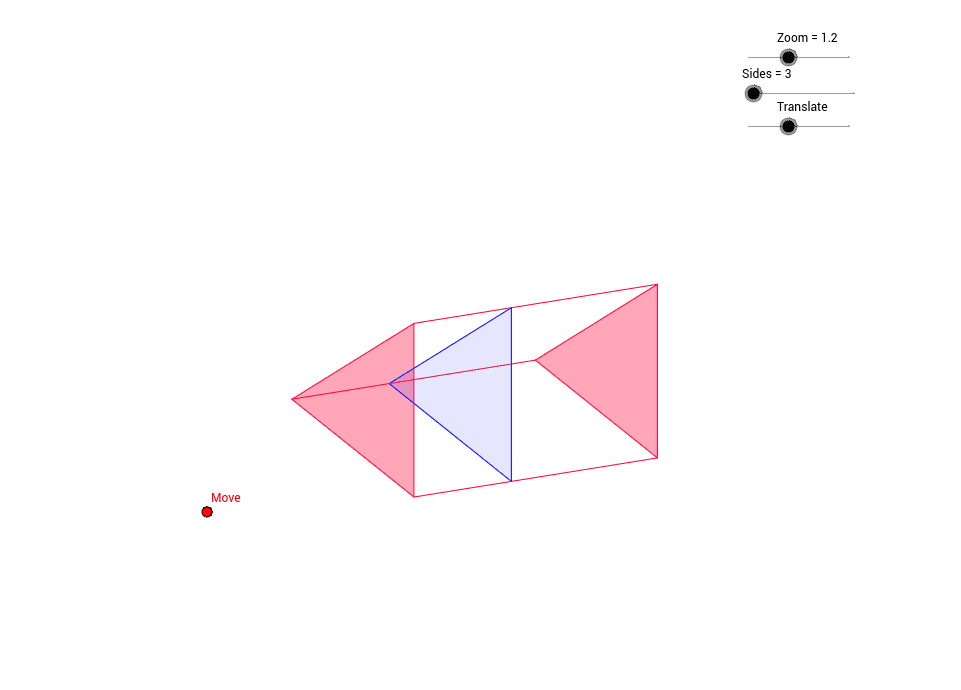
① This example constructs a prism by translating a polygon along a vector and demonstrates that any cross‑section perpendicular to the translation direction has a constant area. ② The core mathematics involve prism geometry, vector translation, area calculation of planar shapes, continuity principles, and the centroid properties of polygons. ③ The construction uses GeoGebra commands such as Vector, Sequence, Polygon, Centroid, and Translate, together with objects like Translate, Sides, F, B, and lists/polygons (list1, poly1, list2, poly2, etc.) to create the dynamic model. ④ It is intended for high‑school or early university students studying geometry and vectors, providing a visual tool for exploring solid geometry, transformations, and area invariance.
GeoGebra Commands & Parameters
Vector(B, C) → vVector(B, E) → uVector(B, D) → wSequence(F - 2 * w * Zoom + Zoom * (sin(i°) * v - cos(i°) * u), i, 0, 360, 360 / Sides) → list2Polygon(list2) → poly2, , , ,Centroid(poly2) → HSequence(F + 2 * w * Zoom + Zoom * (sin(i°) * v - cos(i°) * u), i, 0, 360, 360 / Sides) → list1Polygon(list1) → poly1, , , ,Centroid(poly1) → GSequence(Segment[Element[list1, i], Element[list2, i]], i, 0, Sides) → list3Translate(poly1, z) → poly1'
AI Drawing Prompt Reference
Draw a prism by translating a polygon along a vector to demonstrate that any cross-section perpendicular to the translation direction has a constant area. First, create a polygon, then translate it along a vector to form another polygon of the same shape. Connect the corresponding vertices of the two polygons, and finally combine them to show the centroids of both polygons.
The prompt above was compiled from the original drawing commands and is for reference only.