
Conic Sections by Sérgio Dantas
Loading the math board and drawing, please wait…
In collections
intersection: surface-surface, curve-curve
intersection: surface-surface, curve-curve
intersection: surface-surface, curve-curve
intersection: surface-surface, curve-curve
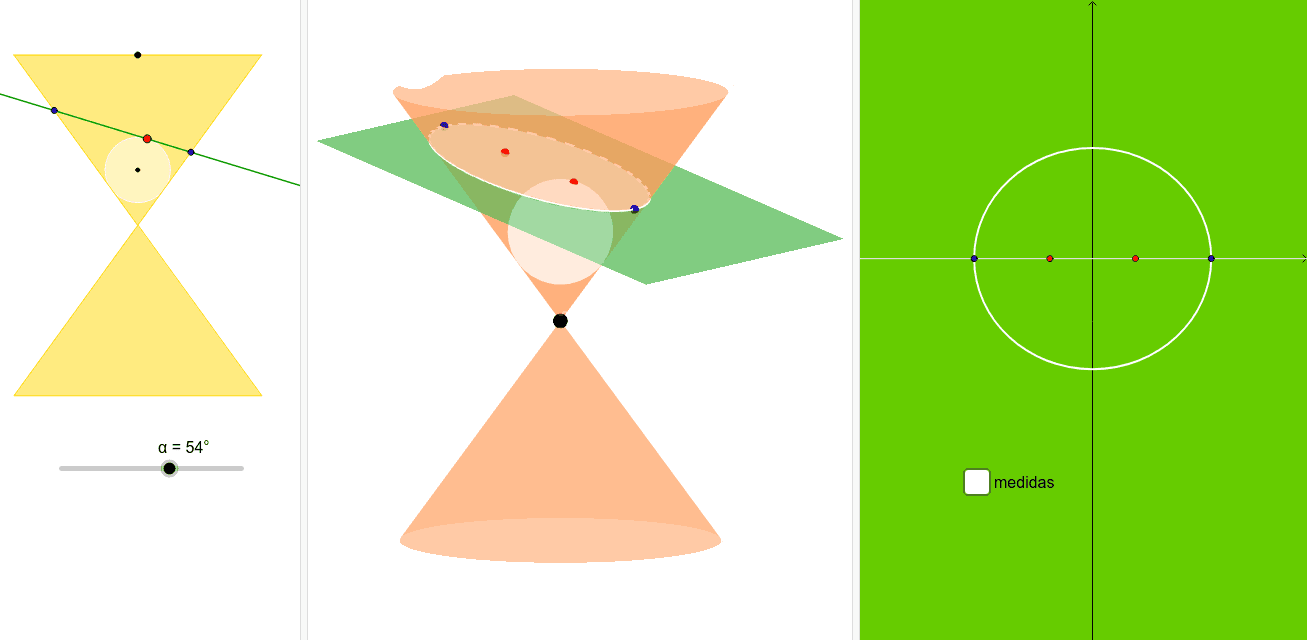
This example demonstrates the formation and properties of conic sections including ellipses, hyperbolas, and parabolas. It involves core mathematical concepts such as coordinate geometry, derivatives, and geometric transformations. GeoGebra commands and objects used include Point, Line, Intersect, Cone, Circle, Tangent, UnitOrthogonalVector, OrthogonalPlane, IntersectPath, Focus, Polygon, Mirror, Sphere, Segment, Ellipse, Hyperbola, Parabola, Angle. Suitable for high school mathematics students and teachers for teaching demonstrations and explorations.
GeoGebra Commands & Parameters
Point(yAxis) → HLine((0, 0), (cos(α), sin(α))) → r_1Intersect(OrthogonalLine[H, yAxis], r_1) → DCone((0, 0, y(H)), (0, 0, 0), Distance[H, D]) → superior, f, gPoint(yAxis) → C_1Intersect(OrthogonalLine[C_1, r_1], r_1) → BCircle(C_1, B) → circ_1Point(circ_1) → G_1Tangent(G_1, circ_1) → s,UnitOrthogonalVector(s) → uOrthogonalPlane((0, x(G_1), y(G_1)), Vector[(0, x(u), y(u))]) → hIntersectPath(h, superior) → c_1Focus(c_1) → F_1, F_2Circle(G_1, Distance[F_1, F_2]) → cIntersect(c, s) → I_2, I_1If(y(I_1) < y(G_1), I_1, I_2) → G_2Polygon((0, 0), D, Mirror[D, yAxis]) → pol1, a, b, dMirror(pol1, (0, 0)) → pol1'Mirror(superior, (0, 0, 0)) → inferiorSphere((0, 0, y(C_1)), Radius[circ_1]) → esf_1Corner(c_1) → F, GIntersectPath(h, inferior) → c_2Corner(c_2) → H_1, IVertex(c_1) → V_1, V_2, M, NMirror(r_1, yAxis) → r_2Intersect(s, r_2) → X_1Intersect(r_1, s) → X_2Segment(Intersect[Circle[(0, 0), D], s, 1], Intersect[Circle[(0, 0), D], s, 2]) → jMirror(A, (0, 0)) → A'Mirror(C, (0, 0)) → C'Ellipse(A, A', C) → eMirror(E, (0, 0)) → E'Hyperbola(A, A', E) → kIf(α ≟ β, (0, Distance[V_1, F_1]), (0, 0)) → JParabola(J, OrthogonalLine[(0, (-y(J))), yAxis]) → pPoint(k) → OIntersectIntersect(c_1, Circle[V_2, Distance[E, O], Vector[OrthogonalVector[h]]]) → L_1, L_2, L, PSegment(A, O) → iIf(y(O) > 0, Segment[F_2, L_2], Segment[F_2, L_1]) → mIf(y(O) > 0, Segment[F_1, L_2], Segment[F_1, L_1]) → nIf(α ≟ β, 1, If[(-α) < β < α, 2, 3]) → qPoint(e) → K_1Segment(A, K_1) → rSegment(K_1, A') → tAngle(C, (0, 0), K_1) → γIntersect(Ray[Center[c_1], Rotate[V_2, γ, Center[c_1], h]], c_1) → K_2, QSegment(F_2, K_2) → a_1Segment(K_2, F_1) → b_1Point(p) → KSegment(J, K) → e_1Segment(K, (x(K), (-y(J)))) → e_2If(α ≟ β, Line[Mirror[F_1, V_1], Tangent[V_1, c_1]]) → lSegment(O, A') → f_1IntersectIntersect(c_1, Circle[V_1, Distance[K, (0, 0)], Vector[OrthogonalVector[h]]]) → R, S, T, UIf(x(K) > 0, Intersect[l, OrthogonalLine[S, l, h]], Intersect[l, OrthogonalLine[R, l, h]]) → V