
Congruent Triangle Problem with Transformations
Loading the math board and drawing, please wait…
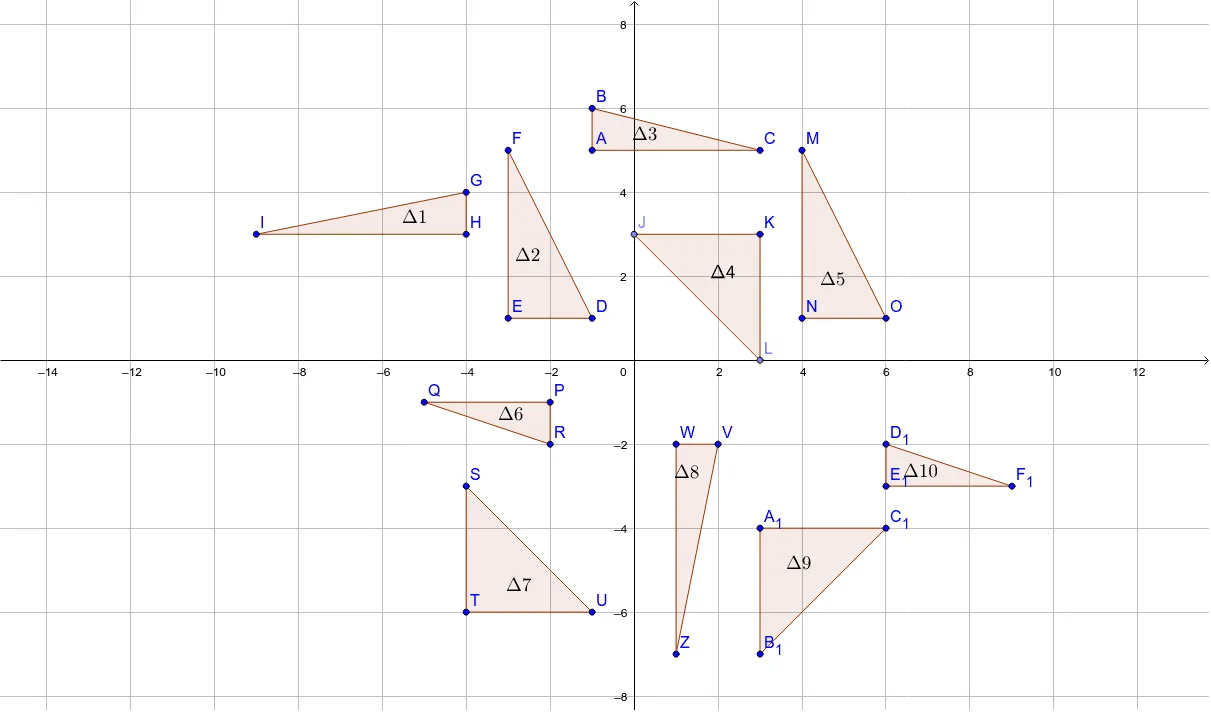
This GeoGebra example demonstrates how to construct multiple sets of congruent triangles using geometric transformations such as translation, rotation, or reflection, and visually verify their correspondence. The core mathematical concepts involve the criteria for triangle congruence (SSS, SAS, etc.) and the property that transformations preserve shape and size. The construction uses the Polygon command to create six triangles (poly1 through poly6), each defined by three points (e.g., A, B, C), and the Point command to generate corresponding vertices (D through R), forming congruent figures through transformations or direct point placement. This resource is ideal for middle school geometry classes, helping students grasp the idea of congruence, the invariant nature of transformations, and how to dynamically test congruence conditions.
GeoGebra Commands & Parameters
Polygon(A, B, C) → poly1, c, a, bPolygon(D, E, F) → poly2, f, d, ePolygon(G, H, I) → poly3, i, g, hPoint(yAxis) → JPoint(xAxis) → LPolygon(J, K, L) → poly4, l, j, kPolygon(M, N, O) → poly5, o, m, nPolygon(P, Q, R) → poly6, r, p, qPolygon(S, T, U) → poly7, u, s, tPolygon(V, W, Z) → poly8, z_1, v, wPolygon(A_1, B_1, C_1) → poly9, c_1, a_1, b_1Polygon(D_1, E_1, F_1) → poly10, f_1, d_1, e_1
AI Drawing Prompt Reference
Draw six congruent triangles, each defined by three points: A, B, C; D, E, F; G, H, I; J, K, L; M, N, O; P, Q, R. Then draw six more congruent triangles, each defined by A1, B1, C1; D1, E1, F1; G1, H1, I1; J1, K1, L1; M1, N1, O1; P1, Q1, R1.
The prompt above was compiled from the original drawing commands and is for reference only.