
Congruent Parts, Part 1: Identifying Corresponding Elements
Loading the math board and drawing, please wait…
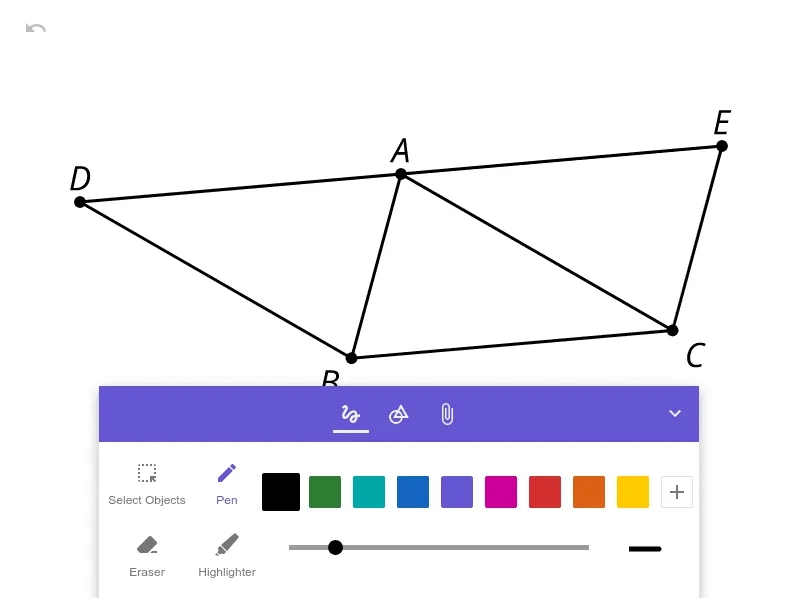
① This practice example from Illustrative Mathematics Geometry Unit 2 Lesson 1 focuses on identifying and labeling corresponding vertices, sides, and angles in congruent polygons, reinforcing the idea that congruence preserves shape and size through rigid motions. ② Core mathematical concepts include congruence, corresponding parts of polygons, and the proper use of congruence notation (≅). ③ Construction notes: The GeoGebra construction summary lists only a single image object (pic1), indicating that the activity primarily uses a static diagram for students to observe and record correspondences; however, teachers can extend it by using GeoGebra's translation, rotation, and reflection tools to dynamically demonstrate how congruent figures map onto each other. ④ This resource is suitable for middle school geometry (grades 8-9) as an in-class exercise or homework, building foundational understanding of congruence before introducing triangle congruence theorems (SSS, SAS, etc.).
AI Drawing Prompt Reference
Draw an equilateral triangle ABC, then draw another equilateral triangle DEF that is congruent to it, making sure corresponding sides and angles are equal. Label the corresponding vertices A and D, B and E, C and F, and the corresponding sides AB and DE, BC and EF, CA and FD, as well as the corresponding angles ∠A and ∠D, ∠B and ∠E, ∠C and ∠F.
The prompt above was compiled from the original drawing commands and is for reference only.