
Congruence? Exploring Congruent Figures via Transformations
Loading the math board and drawing, please wait…
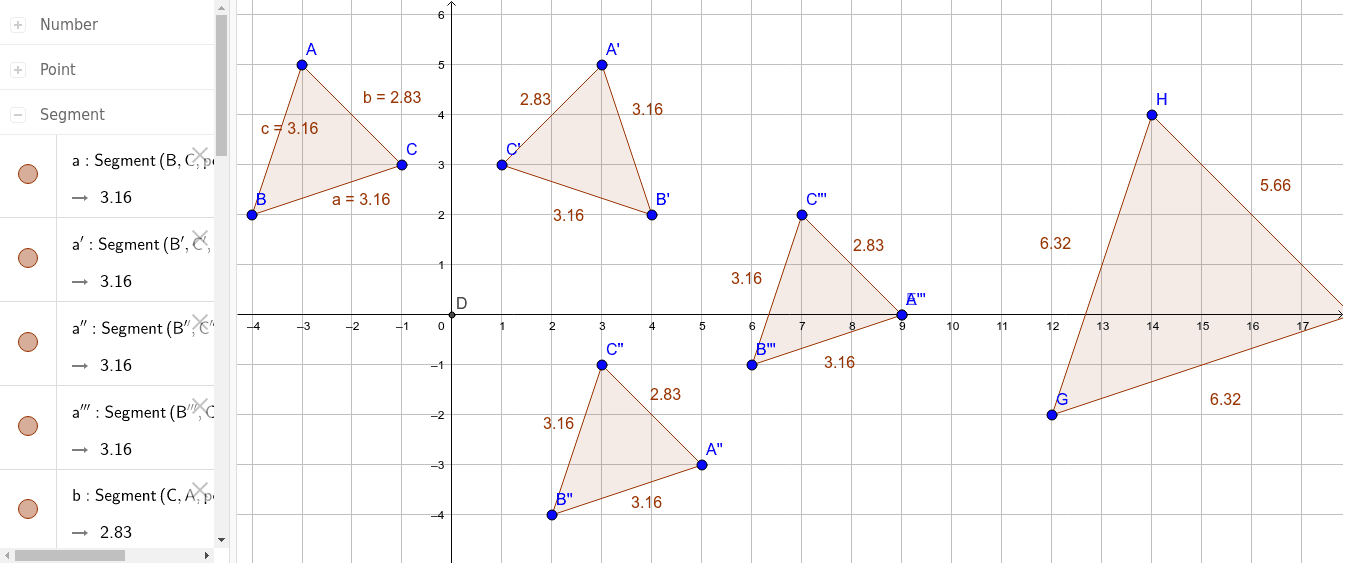
① This GeoGebra example demonstrates whether multiple triangles generated by various geometric transformations (reflection, rotation, translation, dilation) are congruent to the original triangle. ② Core mathematical concepts include congruence, similarity, transformations (reflection, rotation, translation, homothety), and distance measurement, with emphasis on corresponding sides and angles. ③ Construction details: The initial triangle poly1 is created using the Polygon command, then transformed using Mirror, Rotate, Translate, and Dilate to produce copies (poly1', poly1'', poly1'''), while Intersect, Point, Vector, and Distance commands are used to construct auxiliary points and measure lengths, allowing visual and quantitative comparison. ④ Suitable for middle school to high school students learning geometric transformations and congruence criteria, and for teachers to demonstrate how transformations preserve shape and size, and to distinguish congruence from similarity.
GeoGebra Commands & Parameters
Polygon(A, B, C) → poly1, c, a, bMirror(A, yAxis) → A'Mirror(B, yAxis) → B'Mirror(C, yAxis) → C'Polygon(A', B', C') → poly1', c', a', b'Intersect(xAxis, yAxis) → DRotate(A', (-(90°)), D) → A''Rotate(B', (-(90°)), D) → B''Rotate(C', (-(90°)), D) → C''Polygon(A'', B'', C'') → poly1'', c'', a'', b''Point(xAxis) → EVector(A'', E) → uTranslate(A'', u) → A'''Translate(B'', u) → B'''Translate(C'', u) → C'''Polygon(A''', B''', C''') → poly1''', c''', a''', b'''Dilate(A''', 2, D) → FDilate(B''', 2, D) → GDilate(C''', 2, D) → HPolygon(F, G, H) → poly2, h, f, gDilate(E, 2, D) → E'Distance(a, c) → d
AI Drawing Prompt Reference
Draw a triangle, then reflect it across the vertical axis to create a mirror image. Rotate this mirrored triangle 90 degrees counterclockwise about the origin to get a second triangle. Translate this rotated triangle horizontally by a vector to get a third triangle. Finally, dilate the translated triangle by a factor of 2 about the origin to get a fourth, larger triangle. Also, place a point on the horizontal axis and measure the length of one side of the original triangle to compare corresponding sides across all triangles, showing which transformations preserve congruence and which only preserve similarity.
The prompt above was compiled from the original drawing commands and is for reference only.