
Congruence Demonstration
Loading the math board and drawing, please wait…
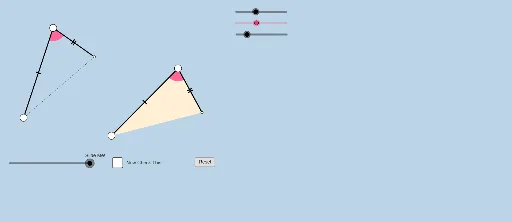
This example demonstrates the construction and properties of congruent figures, showcasing symmetry and invariance through transformations like rotation and reflection. Core mathematical concepts include congruence, rotation, reflection, angles, and vectors. Construction highlights commands and objects such as Circle, Point, Segment, Rotate, Angle, Ray, Intersect, Min, Polygon, CircleSector, Mirror, Line, Dilate, Vector, and Translate. Suitable for high school mathematics, exploring geometric transformations, properties, and introductory applications in coordinate geometry and probability & statistics.
GeoGebra Commands & Parameters
Circle(A, a) → cPoint(c) → BSegment(A, B) → fCircle(A, b) → dRotate(B, α, A) → B'Angle(B, A, B') → βRay(A, B') → gIntersect(d, g, 1) → CSegment(B, C) → hSegment(A, C) → iMin(f, i) → eCircle(A, (0.25 * e)) → kIntersect(k, f) → D,Intersect(k, i) → E,Polygon(A, B, C) → poly1, c_1, a_1, b_1CircleSector(A, D, E) → pMirror(A, h) → A'Mirror(B, h) → B'_1Mirror(C, h) → C'Polygon(A', B'_1, C') → poly1', c', a', b'_1Mirror(p, h) → p'Mirror(A, h) → A'_1Mirror(B, h) → B'_2Segment(A'_1, B'_2) → f'Mirror(A, h) → A'_2Mirror(C, h) → C'_1Segment(A'_2, C'_1) → i'Line(C, B) → jPoint(j) → GPoint(j) → HRay(B, H) → lRay(C, G) → mCircle(F, a) → qPoint(q) → ISegment(F, I) → nRotate(I, α, F) → I'Angle(I, F, I') → γCircle(F, b) → rRay(F, I') → sIntersect(r, s, 1) → JSegment(I, J) → tSegment(F, J) → f_1Dilate(B, If[0 < u ≤ 1, 1 - u, 0], I) → B'_3Vector(B, B'_3) → vTranslate(A, v) → A'_3Translate(B, v) → B'_4Segment(A'_3, B'_4) → f'_1Line(B, n) → g_1Point(g_1) → KAngle(K, B, A) → δRotate(A'_3, If[1 < u ≤ 2, ((-(u - 1)) * δ), (-δ)], I) → LRotate(B'_4, If[1 < u ≤ 2, ((-(u - 1)) * δ), (-δ)], I) → MSegment(L, M) → h_1Dilate(A, If[2 < u ≤ 3, 3 - u, 0], F) → A'_4Vector(A, A'_4) → wTranslate(A, w) → A'_5Translate(C, w) → C'_2Segment(A'_5, C'_2) → i'_1Line(A, f_1) → i_1Point(i_1) → NAngle(N, A, C) → εRotate(A'_5, If[3 < u ≤ 4, ((-(u - 3)) * ε), (-ε)], F) → ORotate(C'_2, If[3 < u ≤ 4, ((-(u - 3)) * ε), (-ε)], F) → PSegment(O, P) → j_1Translate(p, w) → p'_1Rotate(p'_1, If[3 < u ≤ 4, ((-(u - 3)) * ε), (-ε)], F) → d_1Dilate(B, If[4 < u ≤ 5, 5 - u, 0], I) → B'_5Vector(B, B'_5) → u_1Translate(A, u_1) → A'_6Translate(B, u_1) → B'_6Translate(C, u_1) → C'_3Polygon(A'_6, B'_6, C'_3) → poly1'_1, c'_3, a'_6, b'_6Line(B, t) → k_1Point(k_1) → QAngle(Q, B, C) → ζRotate(A'_6, If[5 < u ≤ 6, ((-(u - 5)) * ε), (-ε)], I) → RRotate(B'_6, If[5 < u ≤ 6, ((-(u - 5)) * ε), (-ε)], I) → SRotate(C'_3, If[5 < u ≤ 6, ((-(u - 5)) * ε), (-ε)], I) → TPolygon(R, S, T) → poly2, t_1, r_1, s_1Segment(B, A) → l_1Segment(A, C) → m_1Segment(C, B) → n_1CircleSector(A, D, E) → e_1