
Confidence Interval for µ (σ unknown)
Loading the math board and drawing, please wait…
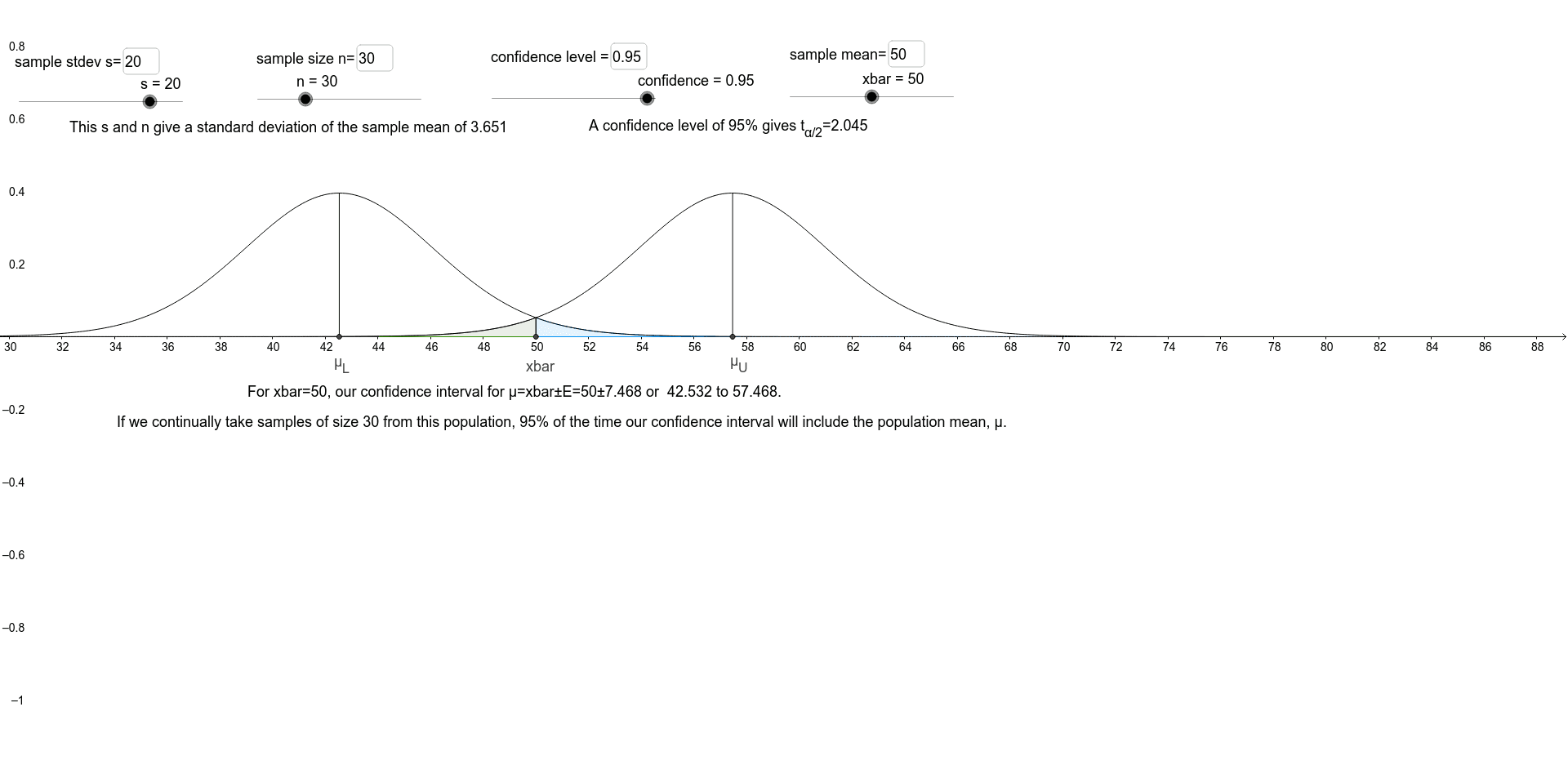
This example demonstrates how to calculate the confidence interval for estimating a population mean (µ) when the population standard deviation (σ) is unknown using GeoGebra. Key mathematical concepts include confidence intervals, t-distribution, sample mean, sample standard deviation, and margin of error. The construction utilizes commands like Segment, Integral, and Textfield, involving objects such as xbar, confidence, n, h, t_α, s, E, μ_L, f, μ_U, g, A, B, a, b, c, C, D, F, G, d, e, inputBox1, inputBox2, inputBox3, inputBox4, text5, text2, text1, text3, text4. Suitable for high school and above students learning statistical inference and confidence interval calculations.
GeoGebra Commands & Parameters
Segment(A, B) → aIntegral(f, xbar, xbar + (3 * E)) → bIntegral(g, xbar - (3 * E), xbar) → cSegment(C, D) → dSegment(F, G) → eTextfield(confidence) → inputBox1Textfield(n) → inputBox2Textfield(xbar) → inputBox3Textfield(s) → inputBox4
AI Drawing Prompt Reference
Draw a confidence interval diagram showing how to calculate the confidence interval for an unknown population standard deviation using sample mean and standard deviation. Include objects like sample mean, sample standard deviation, confidence level, lower and upper bounds of the confidence interval, and explain their relationships.
The prompt above was compiled from the original drawing commands and is for reference only.