
Composition of Two Axial Symmetries
Loading the math board and drawing, please wait…
In collections
geometriadinamica.es
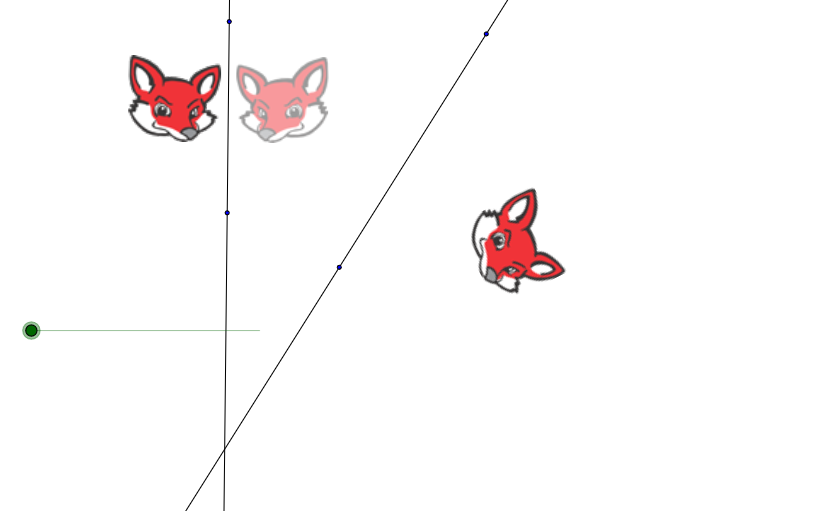
This example demonstrates the graphical transformation phenomenon resulting from the composition of two axial symmetries. The core mathematical concepts involved include axial symmetry, geometric transformations, and angle calculations. The construction utilizes GeoGebra commands and objects such as Line, Mirror, Intersect, Angle, If, and Rotate. It is suitable for high school students studying geometric transformations and parametric equations.
GeoGebra Commands & Parameters
Line(A, B) → aMirror(pic1, a) → pic2Line(C, D) → bMirror(pic2, b) → pic3Intersect(a, b) → EAngle(C, E, B) → αIf(α < pi, (2 * α), (2 * (pi - α))) → βRotate(pic1, ((-2 * c) * α), E) → pic4
AI Drawing Prompt Reference
Draw a geometric transformation diagram: create two intersecting lines as axes of symmetry, place an initial object at their intersection point; first reflect this object across the first line to create the first mirror image, then reflect that image across the second line to create the second mirror image; measure the angle between the two axes and demonstrate that the composition of two axial symmetries equals a rotation (with rotation angle twice the angle between the axes), using the rotated object to verify this conclusion.
The prompt above was compiled from the original drawing commands and is for reference only.