
Composite of Complex Linear Transformations on a Rhombus Grid
Loading the math board and drawing, please wait…
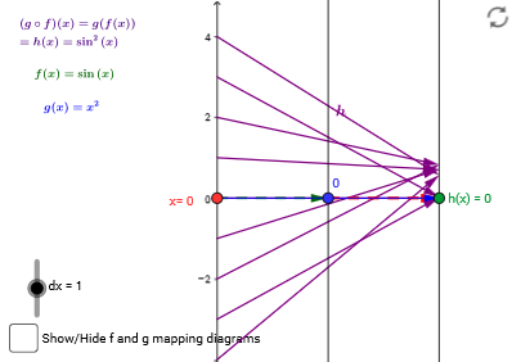
This example demonstrates how composing linear functions with geometric transformations maps a rhombus grid into dynamic iterative patterns on the complex plane. Core mathematical concepts include complex numbers, linear transformations (translation, rotation, scaling), function composition, and sequence generation. Construction highlights: using GeoGebra commands such as Point, Vector, Sequence, Zip, If, and Element to build base points and vectors, with sliders h and n controlling iteration steps and scaling factors, ultimately producing composite images of functions f and g along with text labels. Suitable for high school to undergraduate students studying the geometric meaning of complex numbers, linear transformations, and function iteration, as well as for teachers demonstrating how transformations affect shapes.
GeoGebra Commands & Parameters
Point(yAxis) → AElement(hlist_1, n) → hIf(n ≟ 1, (2, f1(y(A))), (2, f2(y(A)))) → BVector(A, B) → uVector(B, C) → vVector(A, C) → wSequence(k, k, -4, 4, dx) → x_*Zip((y(A) + k, h(y(A) + k)), k, x_*) → hptlistElement(f1list, n) → fZip(Vector[(0, k), (x(C), h(k))], k, x_*) → hlistZip(Vector[(0, k), (x(B), f(k))], k, x_*) → glistZip(Vector[(x(B), f(k)), (x(C), h(k))], k, x_*) → fglist