
Complex Numbers: What's My Rule?
Loading the math board and drawing, please wait…
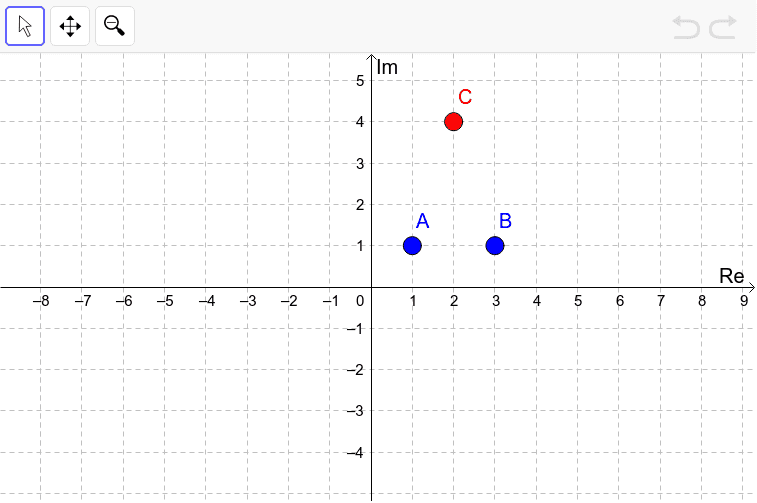
This GeoGebra example demonstrates an interactive exploration of point transformations in the complex plane. Users drag points A and B, which represent complex numbers, and observe how point C moves in response, then attempt to deduce the rule (such as addition, multiplication, or a linear combination) that defines C from A and B. The core mathematical concepts include geometric representation of complex numbers, operations on the complex plane, and function mapping. Construction details: the objects A, C_1, B, and C are used, where C_1 may serve as an auxiliary point or intermediate variable; GeoGebra's dynamic algebra-geometry linkage computes C's position in real time based on A and B's coordinates. This is suitable for high school or early college students exploring the geometric meaning of complex operations, and for teachers designing inquiry-based activities that foster observation, conjecture, and verification skills.
GeoGebra Commands & Parameters
Point A(1.0, 1.0)(0, y(A))Point B(3.0, 1.0)(A * B)
AI Drawing Prompt Reference
Draw two draggable points on the complex plane representing two complex numbers, with one initially at the upper right and the other horizontally to the right. Drop a perpendicular from the first point to the real axis and mark the foot. Then plot a third point whose position is determined by the product of the first two complex numbers, with real and imaginary parts computed by complex multiplication. Mark all three points as solid dots and show a coordinate grid, so that dragging either input point reveals how the third point moves, allowing inference of the transformation rule.
The prompt above was compiled from the original drawing commands and is for reference only.