
Complex Numbers and Geometry: Exploring the Locus of Point C
Loading the math board and drawing, please wait…
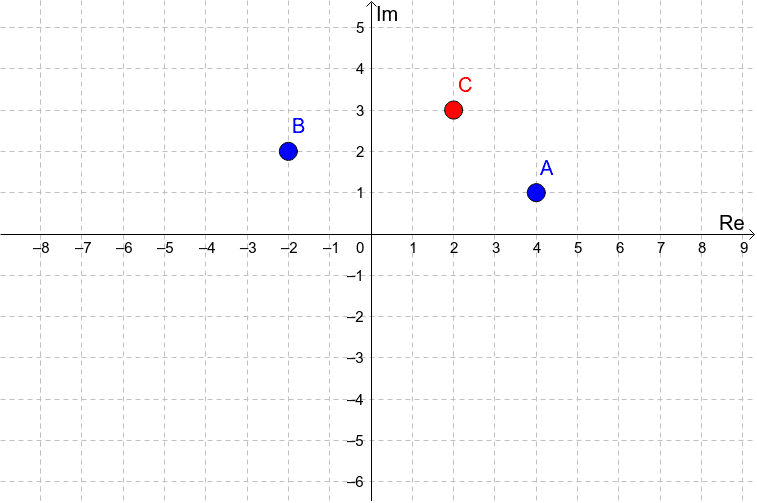
This example demonstrates the application of complex numbers in geometric figures. Key mathematical concepts include complex number operations, geometric transformations, and locus analysis. Construction involves using GeoGebra commands A, C_1, B, C to dynamically adjust point positions. Suitable for high school students learning the integration of complex numbers with geometry and understanding their significance in coordinate geometry.
GeoGebra Commands & Parameters
Point A(4.0, 1.0)(0, y(A))Point B(-2.0, 2.0)A + B
AI Drawing Prompt Reference
On a coordinate plane, start by placing a point at (4, 1). Then, draw a vertical line from this point down to the x-axis, marking the foot of the perpendicular. Next, place another point at (-2, 2). Finally, combine these two points by vector addition, resulting in a new point whose coordinates are the sum of the two original points. The diagram illustrates a dynamic geometric construction where point positions can be adjusted, demonstrating how complex number operations manifest in geometry, particularly for exploring the locus of the resulting point as the initial points move.
The prompt above was compiled from the original drawing commands and is for reference only.